Analisi esperta di Untitled di Mark Rothko
Stile: Surrealism · Genere: figurative
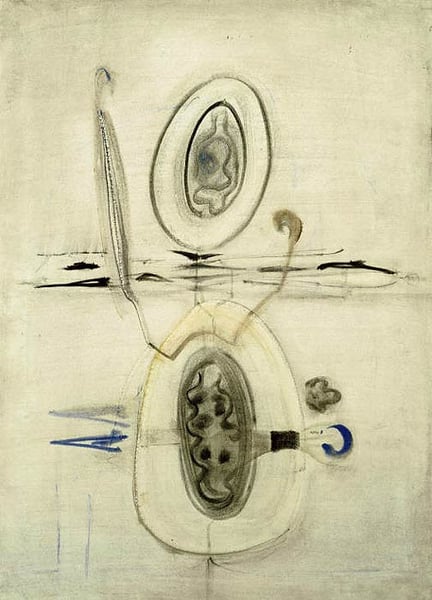
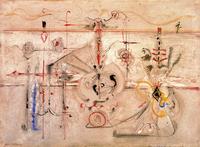
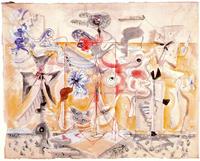
While Mark Rothko is primarily celebrated for his iconic Color Field abstractions, the supplied facts position "Untitled" within his earlier, less recognized phase: Surrealism with a figurative approach. This is significant because it reveals the foundational concerns that would later define his mature work.
Analysis of Significance:
-
A Bridge from Surrealism to Abstraction: In the late 1930s and early 1940s, Rothko was deeply influenced by Surrealist automatism and mythic imagery. This "Untitled" likely belongs to that period, where recognizable human or organic forms (the "figurative" element) are distorted, floating, or merged with biomorphic shapes. This work is not a departure from his famous canvases but a crucial step: here, Rothko uses the figure as a vessel for primordial emotion, a strategy he would later distill into pure, vibrating rectangles of color. The significance lies in seeing how Rothko moved from depicting mythic beings to evoking mythic states of being.
-
Challenging Surrealism's Conventions: While Surrealism often relied on dreamlike dislocation and psychological shock, Rothko's figurative Surrealism is more somber and introspective. The figures in this work are likely shadowy, isolated, or trapped—hinting at the existential anxiety and search for transcendence that would define his later "multiforms." This makes the piece significant as an example of Surrealism being repurposed not for the bizarre, but for the sublime.
-
The "Figurative" as a Prelude to the "Icon": Rothko famously said that his later works were about "the human drama." In this figurative Surrealist piece, that drama is still embodied in a recognizable human (or quasi-human) form. The significance here is that Rothko never truly abandoned figuration; he abstracted it. The hovering, undefined space of this work—where figures exist in a hazy, atmospheric void—directly prefigures the luminous fields of his mature paintings. Studying this "Untitled" allows us to trace the evolution from a Surrealist vocabulary to the iconic, transcendent silence of the Rothko Chapel.
Conclusion: As a Surrealist figurative work by Rothko, this artwork is significant not as an outlier, but as the necessary root system from which his revolutionary abstract expressionism grew. It reminds us that his later masterpieces are not devoid of content, but are instead the ultimate distillation of the very human, mythic, and emotional content first explored in these early, figurative Surrealist experiments.
Visivamente simili
20 opere con composizione e palette affini
Biostructure
Florin Maxa
Universe for Child's Room
George Saru
Black Edge II
Frank Lobdell
The Family
Joan Miro
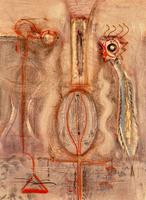
Untitled
Mark Rothko
Untitled
Eileen Agar
Untitled
Richard Pousette-Dart
Suite Dibuixos Podrits
Joan Ponc
The Gramineous Bicycle Garnished with Bells the Dappled Fire Damps and the Echinoderms Bending the Spine to Look for Caresses
Max Ernst
Untitled
Leon Arthur Tutundjian
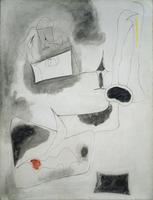
Nude
Arshile Gorky
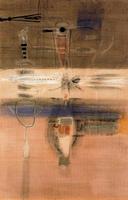
Untitled
Mark Rothko
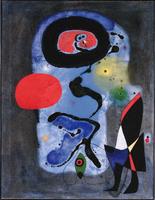
The Red Sun
Joan Miro
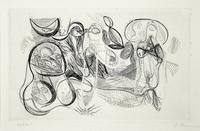
Detail
Serge Brignoni
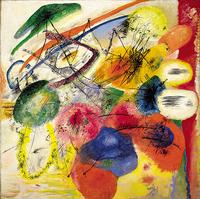
Black strokes I
Wassily Kandinsky
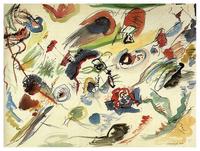
Untitled (First abstract watercolor)
Wassily Kandinsky
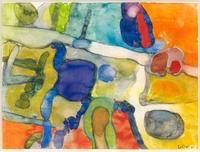
L'Eau Verte
Maurice Esteve
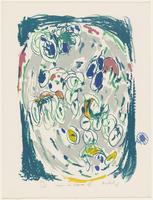
Waterzooi from the portfolio Pencil on Shell
Pierre Alechinsky
Archaic Idol
Mark Rothko
Untitled
Mark Rothko