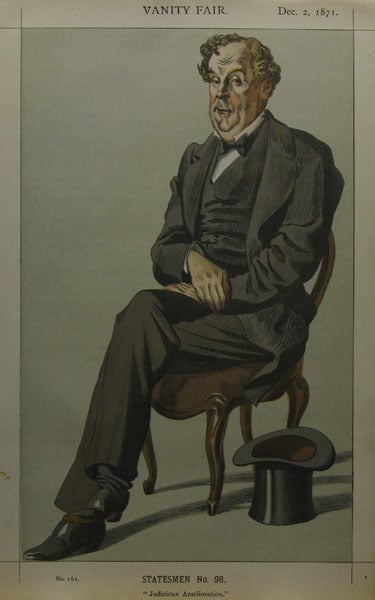
Statesman No.098° - Caricature of Alexander Baillie Cochrane M.P.
Details
Expertenanalyse zu James Tissots Statesman No.098° - Caricature of Alexander Baillie Cochrane M.P.
Stil: Realism · Genre: caricature
Expert Analysis of James Tissot's Statesman No.098° – Caricature of Alexander Baillie Cochrane M.P.
James Tissot's Statesman No.098° occupies a fascinating intersection between the meticulous observation of Realism and the pointed exaggeration of caricature. While Tissot is celebrated for his finely rendered, almost photographic depictions of contemporary life—especially in his scenes of fashionable Parisian and London society—this work demonstrates his ability to apply Realism’s commitment to accurate likeness and detail to a genre that typically prioritizes distortion and humor.
The significance of this piece lies in how Tissot leverages Realist technique to lend credibility to satire. Unlike many caricaturists of the era, who emphasized grotesque exaggeration, Tissot grounds the portrait in a believable, naturalistic rendering of Alexander Baillie Cochrane. The subject’s features are depicted with the same crisp precision Tissot used for his society portraits: careful modeling of bone structure, subtle gradations of light and shadow, and attention to fabric and texture. This Realist foundation makes the caricatural elements—likely an elongation of the nose, a cynical set of the jaw, or a theatrical posture—feel less like fantasy and more like an unflatteringly honest document of the man’s character.
The work is also historically significant as part of Tissot’s engagement with Victorian political life. During his London period (1870s–1880s), he became an acute observer of British society, including its political class. The systematic numbering (“No.098°”) suggests a series, possibly for a publication or portfolio, indicating that Tissot saw political caricature as a serious artistic and journalistic endeavor. By applying the rigorous standards of Realism to the traditionally looser genre of the caricature, Tissot elevated the form, bridging the gap between fine art and political commentary.
In summary, Statesman No.098° is significant as a hybrid work that uses Realism’s fidelity to truth as a weapon for satirical effect. It exemplifies how an artist of Tissot’s calibre could move between high-art realism and popular caricature without sacrificing technical mastery, and it offers a uniquely nuanced—and therefore more damning—portrait of a Victorian politician.
Visuell ähnlich
20 Werke mit ähnlicher Komposition und Farbpalette
Man of the day No.31° - Caricature of The Duke of Saldanha
James Tissot
Statesman No.130° - Caricature of Mr Roger Eykyn, Liberal M.P. for Windsor
James Tissot
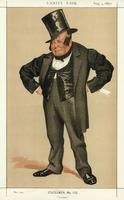
Statesman No.120° - Caricature of James Delahunty M.P.
James Tissot
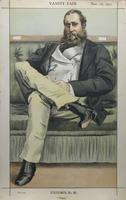
Statesman No.096° - Caricature of Lionel Dawson Damer M.P.
James Tissot
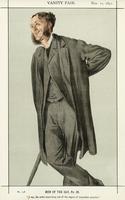
Man of the day No.36° - Caricature of Matthew Arnold
James Tissot
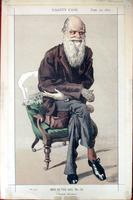
Man of the day No.33° - Caricature of Charles Darwin from Vanity Fair magazine
James Tissot
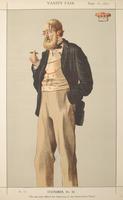
Statesman No.093° - Caricature of The Duke of Rutland
James Tissot
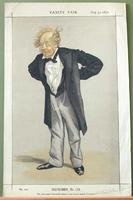
Statesman No.123° - Caricature of The Rt.Hon. C.P. Villiers M.P.
James Tissot
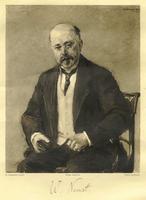
Walther Nernst
Max Liebermann
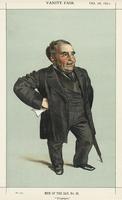
Man of the day No.35° - Caricature of John Pender
James Tissot
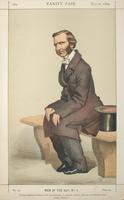
Man of the day No.01° - Caricature of The Rev.Frederick Temple
James Tissot
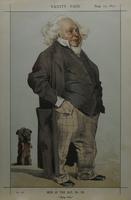
Man of the day No.29° - Caricature of Henry Cole
James Tissot
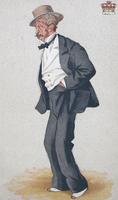
Caricature of Thomas Egerton, 2nd Earl of Wilton
James Tissot
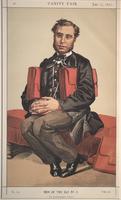
Man of the day No.03° - Émile Ollivier
James Tissot
Portrait of Eugene `Lacheur
Gustave Moreau
Portrait Johann Erdmann Gottlieb Prestel (1804-1885) (probably)
Leopold Pollak
August Förster, German actor and theatre director
Josef Kriehuber
Man sitting frontally in an armchair
Diogène Maillart
Seated Man with a Beard
Vincent van Gogh
Statesman No.101° - Caricature of George Cavendish Bentinck
James Tissot