
Analisi esperta di The Screen di Paul Delvaux
Stile: Surrealism · Genere: genre painting
Expert Analysis of "The Screen" by Paul Delvaux
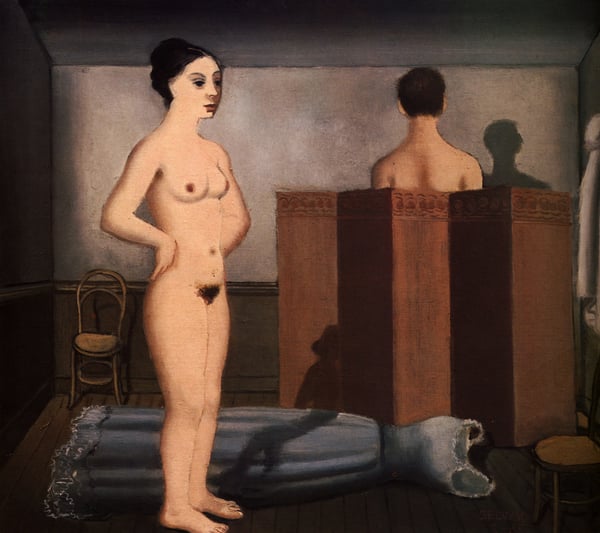
Paul Delvaux’s The Screen is a quintessential example of Surrealist genre painting—a deceptively domestic scene transformed into an uncanny, dreamlike tableau. The work is significant for its masterful blending of meticulous realism with irrational, psychologically charged juxtapositions, a hallmark of Delvaux’s mature style. While most Surrealists embraced automatic techniques or biomorphic abstraction, Delvaux remained a steadfast "magic realist," rendering his visions with the crisp precision of a classical academic painter. This tension between precise technique and impossible content lies at the heart of the work’s power.
The painting depicts a quiet interior—likely a bourgeois room or a public space rendered ambiguous—where a female figure stands or sits near a folding screen. As in much of Delvaux’s oeuvre, the female form is central, often portrayed with a detached, almost mannequin-like stillness. This is not a portrait of a specific woman but an archetype of desire, mystery, or the subconscious. The screen itself is a key surrealist prop: a functional object that partitions space yet becomes a theatrical veil, suggesting voyeurism, concealment, and the thresholds between reality and fantasy. Delvaux frequently borrowed motifs from his predecessors—the empty train stations of Giorgio de Chirico, the draped mannequins of Magritte—but here he grounds the fantastical in the familiar genre of everyday life.
The work’s significance within Surrealism lies in its subversion of the ordinary. A genre painting traditionally depicts humble, narrative scenes of daily existence. Delvaux infiltrates that genre with incongruous elements: an unnerving stillness, a lack of clear action, and a pervasive atmosphere of suspended time. The viewer is left to wonder—is this a moment of waiting, a dream, a memory, or a voyeuristic glimpse into a private ritual? The screen, rather than dividing space, seems to frame an enigma. Delvaux’s fascination with classical architecture, skeletal skeletons, and Victorian dress often appears in other works, but here the simplicity of the setting amplifies the psychological tension.
Ultimately, The Screen exemplifies Delvaux’s contribution to Surrealism: not as a rebel against form, but as a poet of the subconscious who believed that the most unsettling truths reside not in chaos, but in the frozen stillness of a scene that refuses to explain itself. It is a painting that questions the boundary between seeing and knowing, inviting us to peer past the screen of reality.
Visivamente simili
20 opere con composizione e palette affini
The Temptation of Saint Anthony
Paul Delvaux
A Visit
Paul Delvaux
Before bathing
Paul Delvaux
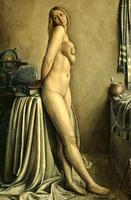
La Langoureuse
François Barraud
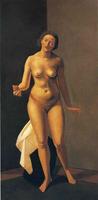
Female nude holding apple
Andre Derain
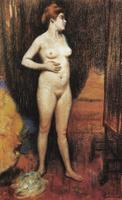
Naked woman in the mirror
Federico Zandomeneghi
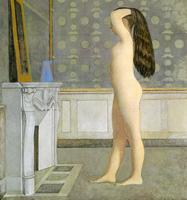
Figure in Front of a Mantel
Balthus
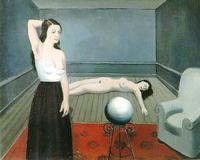
Ball
Paul Delvaux
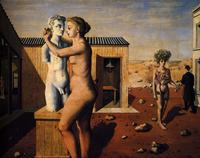
Pygmallion
Paul Delvaux
Stehender Mädchenakt Mit Dolch (lukretia)
Otto Mueller
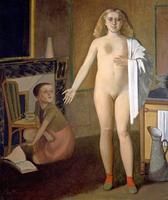
The Room
Balthus

On Her Knees
Andrew Wyeth
Nude with Boots
Suzanne Valadon
The nude with raised arms
Camille Bombois
Woman Arranging her Hair in the Bath
Felix Vallotton
In Front of the Mirror
Wilhelm Gallhof
Body of a Girl
Henri Matisse
The Vigil
Paul Delvaux
Naked
Raoul Dufy
Artemis
Vilhelm Hammershoi