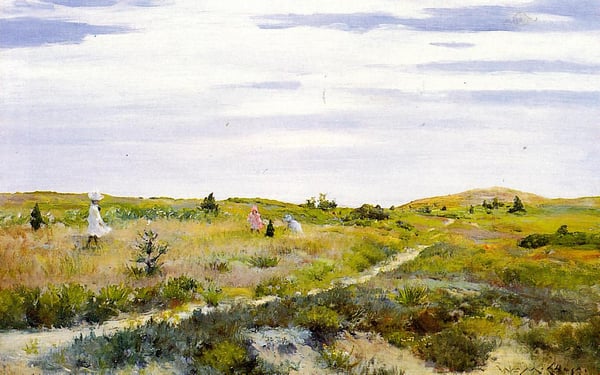
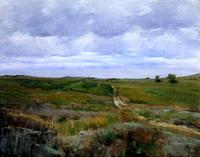
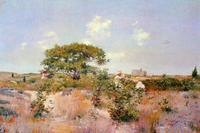
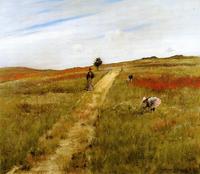
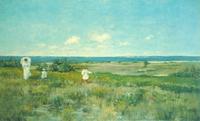
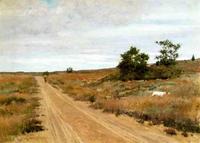
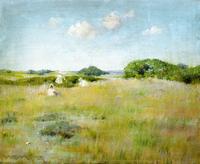
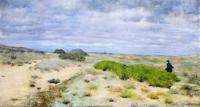
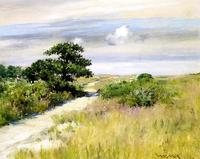
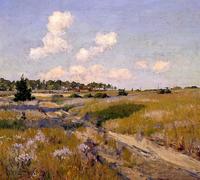
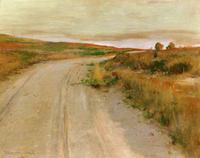
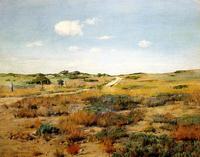
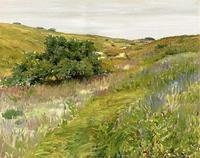
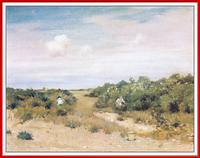
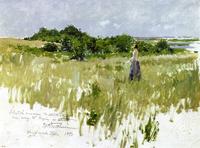
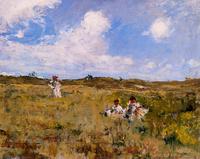
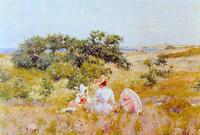
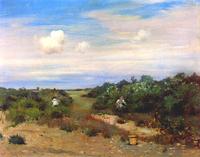
"Along the Path at Shinnecock" exemplifies William Merritt Chase’s mastery of American Impressionism, a style he helped popularize in the late 19th century. The work captures the sun-dappled landscape of Long Island’s Shinnecock Hills, where Chase established the first summer school of plein air painting in the United States. Its significance lies in how Chase adapts French Impressionist techniques—such as loose brushwork, a bright palette, and an emphasis on natural light—to distinctly American scenery. The path itself serves as a compositional device, drawing the viewer into the scene while also reflecting the Impressionist interest in everyday, transient moments. By focusing on the interplay of light and shadow on grass, foliage, and sky, Chase demonstrates his ability to balance atmospheric effects with a solid sense of structure, a hallmark that distinguished his work from more radical European counterparts. This painting thus stands as a key example of how American Impressionism merged European innovation with a sense of national identity and place.