Expert analysis of William Merritt Chase’s Reclining Nude
Style: Impressionism · Genre: nude painting (nu)
Expert Analysis of William Merritt Chase’s Reclining Nude (c. 1880s–1890s)
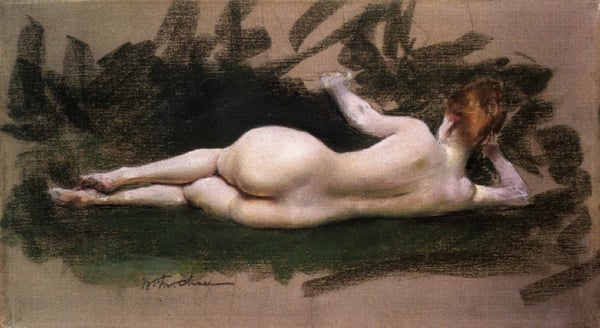
As an American Impressionist, William Merritt Chase approached the traditional subject of the reclining nude with a distinctly modern sensibility. This work belongs to a small but significant body of nudes Chase produced, which mark a pivotal moment in the late 19th-century American art scene—a period when such subject matter was still considered daring and often reserved for European masters.
Stylistic Significance within Impressionism
Chase’s Reclining Nude exemplifies how American artists adapted French Impressionist techniques to a more structured, academic sensibility. The painting’s significance lies in its fusion of loose, vibrant brushwork (capturing the play of light across the figure’s skin and the surrounding drapery) with a firmly modeled, three-dimensional form—a departure from the more ethereal, form-dissolving treatments of Impressionist nudes by Degas or Renoir. Chase’s use of opaque, broken color to define the torso and limbs while retaining a sense of volume reveals his training at the Munich Academy and his admiration for Velázquez and Manet.
Genre and Context
As a nude painting (nu), this work asserts the legitimacy of the nude in American art. In the 1880s, when Chase was teaching at the Art Students League and the Pennsylvania Academy of the Fine Arts, such a frank depiction of a female figure—neither mythological nor allegorical, but simply a modern woman at rest—challenged Victorian propriety. The reclining pose, reminiscent of Titian’s Venus of Urbino and Manet’s Olympia, is updated through an American Impressionist lens: the setting is intimate and unpretentious, the lighting natural and diffused, and the model’s body treated with matter-of-fact realism rather than idealized perfection.
Contribution to American Impressionism
What makes Reclining Nude significant is not just its technical merit but its role in bridging European tradition and American innovation. At a time when many American painters shied away from the nude for fear of scandal, Chase embraced it as a vehicle for exploring pure pictorial values—color, light, and surface texture. The painting stands as a testament to Chase’s versatility and his insistence that American art could hold its own against the European avant-garde, all while retaining a distinctive realism and psychological directness.
In summary, Reclining Nude is a landmark work that demonstrates how William Merritt Chase synthesized Impressionist color and handling with a solid, classically grounded approach to the human form. It remains a key example of the nude’s re-emergence in American painting and a testament to the artist’s boldness in embracing a subject that would later become central to modernism.
Museum / Gallery
Visually similar
20 works with related composition and palette
Nude back
Zinaida Serebriakova
Nude Recumbent
William Merritt Chase
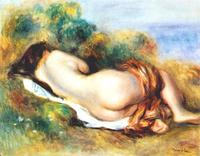
Reclining nude
Pierre-Auguste Renoir
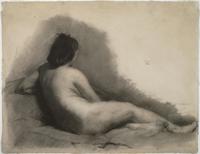
Portraits
Thomas Eakins
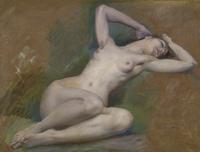
Study for the figure of "Spring" at l'Opéra-Comique, Paris
Luc-Olivier Merson
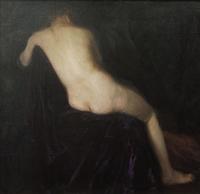
Nude
Leon Wyczółkowski
Reclining nude
Emmanuel Benner
Reclining nude
Moise Kisling
Reclining Nude Figure of a Girl
Thomas Dewing
Saimi's Back
Eero Järnefelt
Nude with Red Stockings
Giuseppe De Nittis
Female nude
Andre Derain
Nude
Stefan Luchian
Naked Lying Back
Suzanne Valadon
Lying Nude
Lesser Ury
Pure (The Model)
William Merritt Chase
Back of a Nude
William Merritt Chase
Reclining female nude
Diogène Maillart
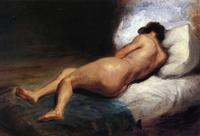
Study of a Reclining Nude
Eugene Delacroix
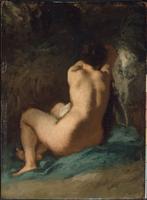
Seated Nude
Jean-Francois Millet