Expertenanalyse zu Maxime Maufras Dessert
Stil: Post-Impressionism · Genre: still life
Expert Analysis of Dessert by Maxime Maufra
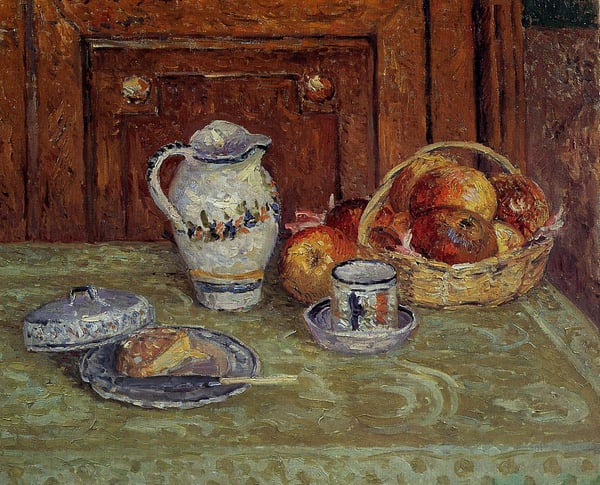
Maxime Maufra’s Dessert is a still life executed in the Post-Impressionist style, a movement that sought to move beyond Impressionism’s naturalistic focus on light and atmosphere in favor of greater emotional resonance, structural order, and symbolic color. Within this context, Maufra’s work is significant for its personal interpretation of a humble, everyday subject—a dessert—as a vehicle for formal experimentation and expressive power.
As a Post-Impressionist still life, Dessert likely abandons the fleeting, casual appearance of a tabletop arrangement in favor of a more deliberately constructed composition. Maufra, who was associated with the Pont-Aven School and deeply influenced by Paul Gauguin, often employed bold, unmodulated color and simplified, rhythmic forms to convey mood and structure rather than mere visual accuracy. This painting would have used strong outlines and flattened perspective, characteristic of the synthetist approach, to transform fruit, plates, and tablecloth into a patterned, almost decorative ensemble that prioritizes the artist’s inner vision over optical reality.
What makes Dessert particularly noteworthy within its period is how it exemplifies Post-Impressionism’s shift from observing nature to reinterpreting it through the artist’s temperament. By choosing a still life—a genre traditionally associated with quiet realism—Maufra demonstrates that even the most ordinary subject can be elevated into a realm of intense color harmony and subjective feeling. The dessert table becomes a stage for controlled, vibrant contrasts (perhaps deep blues against warm yellows, or green glass against red fruit) that generate a sense of vitality and even symbolic richness. This aligns with the broader Post-Impressionist goal of using art to express emotion and idea, not just to document appearances.
In summary, Dessert holds significance as a work that synthesizes Maufra’s Post-Impressionist training—his debt to Gauguin, his love of Brittany’s landscapes, and his commitment to strong, personal expression—into the still-life genre. It stands as a testament to how Post-Impressionism revitalized ordinary subjects, turning a simple dessert into a resonant, artistically autonomous object of contemplation.
Museum / Gallery
Visuell ähnlich
20 Werke mit ähnlicher Komposition und Farbpalette
Still Life with a Chest of Drawers
Paul Cezanne
Blue Tablecloth
Igor Grabar
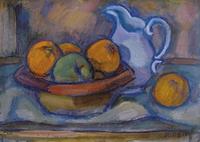
Still Life with Apples and Jug
Kmetty János
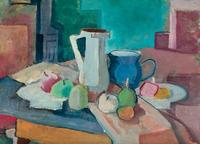
Still Life with Apples and Pears
Kmetty János
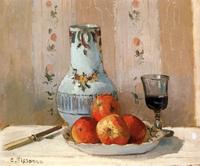
Still Life with Apples and Pitcher
Camille Pissarro
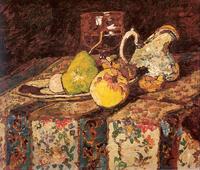
Still Life with White Pitcher
Adolphe Joseph Thomas Monticelli
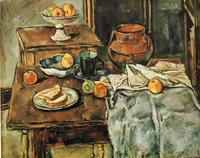
Still Life with Two Tables
Max Weber
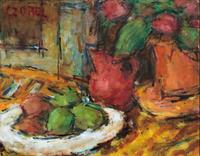
Bela Adalbert Czobel Still Life Wit Flowers and
Bela Czobel
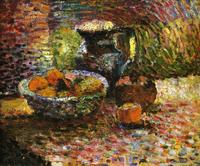
Still Life with Pitcher and Fruit
Henri Matisse
Czobel Still Life Gyümölcsökkel
Bela Czobel
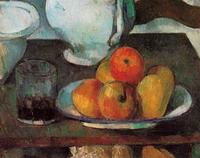
Still Life with Apples
Paul Cezanne
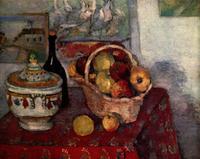
Still Life with Soup Tureen
Paul Cezanne
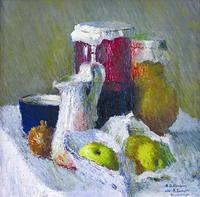
Jam Jar and Apples
Igor Grabar
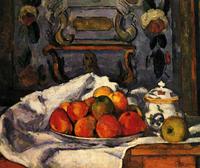
Dish of Apples
Paul Cezanne
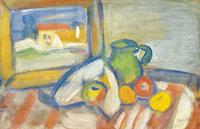
Still Life on Table with a Picture
Kmetty János
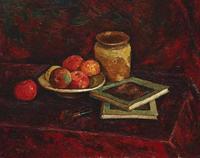
Still Life With Pipe and Books
Adam Baltatu
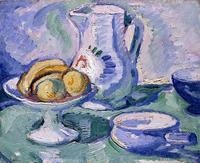
Jug and Yellow Fruit
Samuel Peploe
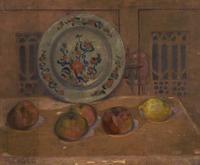
Still Life with Plate and Apples
Harry Phelan Gibb
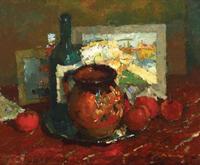
Still Life With Red Pot and Apples
Adam Baltatu
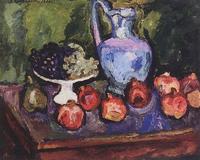
Still Life. Fruits.
Pyotr Konchalovsky