Expert analysis of Childe Hassam’s Village Scene
Style: Impressionism · Genre: landscape
Expert Analysis: "Village Scene" by Childe Hassam
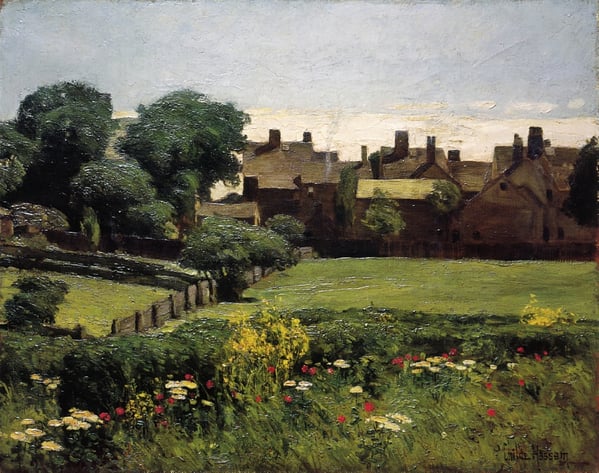
Childe Hassam was a leading figure in American Impressionism, and “Village Scene” exemplifies how he adapted the French Impressionist idiom to distinctly American subjects. Painted with the characteristic broken brushwork and luminous palette of the movement, this landscape captures a quiet, sun-drenched moment in a rural New England village. Hassam’s signature approach—emphasizing the play of light and shadow rather than precise detail—transforms an ordinary scene into a shimmering study of atmosphere.
Significance within Impressionism:
-
Americanization of the Style: While French Impressionists often focused on urban Paris or coastal resorts, Hassam turned to the vernacular architecture and rolling hills of the American Northeast. In “Village Scene,” the unassuming houses, dirt road, and native trees become vehicles for exploring the same optical effects that Monet and Pissarro achieved in their landscapes. This localization made Impressionism feel accessible and relevant to American audiences.
-
Capturing Transient Light: Hassam’s distinctive use of high-key color and short, dappled strokes—visible in the flickering greens of the foliage and the warm whites of sunlit clapboard—demonstrates his mastery of capturing fleeting moments. The painting likely shows late morning or early afternoon light, with long shadows and a soft haze that unify the composition, a hallmark of Impressionist plein-air practice.
-
Narrative of Rural Simplicity: Unlike the more dramatic or picturesque depictions of the American wilderness by earlier Hudson River School artists, Hassam’s “Village Scene” values quiet domesticity. The absence of evident human activity directs the viewer’s eye to the interplay of nature and built form, suggesting a harmonious, unspoiled way of life—a theme that resonated with nostalgic turn-of-the-century America.
In sum, “Village Scene” is significant not only for its technical execution—vibrant color, loose brushwork, and atmospheric sensitivity—but for how it places American identity at the heart of the Impressionist project. It stands as a testament to Hassam’s role in proving that the movement’s principles could thrive beyond Europe, capturing the unique light and spirit of the American landscape.
Visually similar
20 works with related composition and palette
Springtime in Sussex
Tom Roberts
High View, Fish Pond
Lucien Pissarro
Fylde Farm
L. S. Lowry
The Rising Path
Alfred Sisley
The Way to Locquirec
Felix Vallotton
View of the normandy coast near wargemont
Pierre-Auguste Renoir
Turning Road at Montgeroult
Paul Cezanne
Morvan, The Little Mill
Camille Corot
Middlebrook Farm
John Henry Twachtman
White House at Audierne
Roger de La Fresnaye
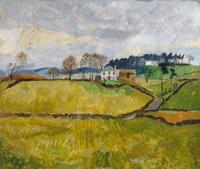
Cumberland Landscape (Northrigg Hill)
Christopher Wood
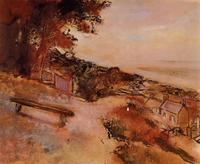
Landscape by the Sea
Edgar Degas
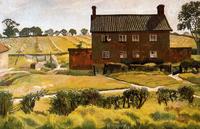
The Red House. Wangford.
Stanley Spencer
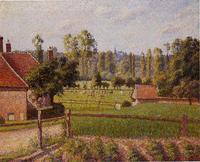
A Meadow in Eragny
Camille Pissarro
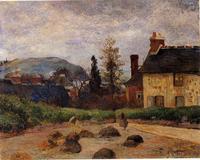
Returning from the harvest (Manuring)
Paul Gauguin
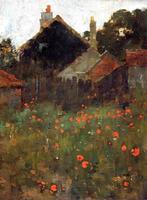
The Poppy Field
Willard Metcalf
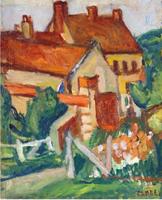
Béla Czóbel
Bela Czobel
Terry's Lane, Cookham
Stanley Spencer
Before the Storm, Tintagel, Cornwall
Algernon Talmage
Sárga Házak Piros Tetők
Bela Czobel