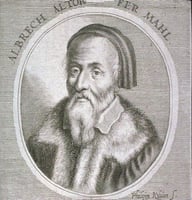
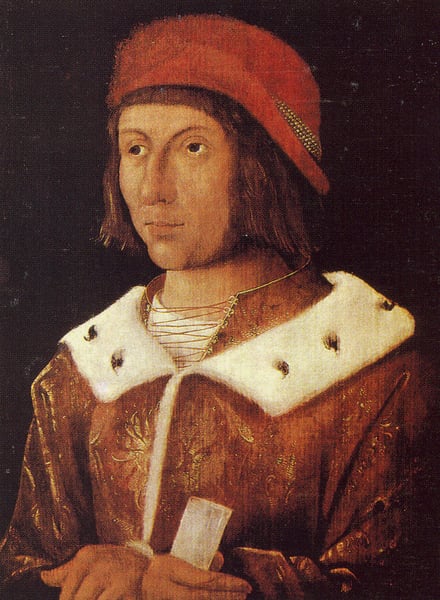
Friedrich der Siegreiche
Analisi esperta di Friedrich der Siegreiche di Albrecht Altdorfer
Stile: Northern Renaissance · Genere: portrait
Albrecht Altdorfer’s Friedrich der Siegreiche (Frederick the Victorious) stands as a compelling example of Northern Renaissance portraiture, a genre in which Altdorfer brought his distinctive fusion of meticulous realism and symbolic depth. Although primarily renowned for his pioneering landscapes and atmospheric religious scenes, Altdorfer here applies his keen eye for detail and character to the representation of the Elector Palatine, Frederick I. The portrait’s significance lies in its balance between naturalistic likeness and emblematic grandeur—a hallmark of Northern Renaissance art that sought to convey both the sitter’s individuality and their political or moral stature.
True to the period’s emphasis on precise observation, Altdorfer captures Frederick’s features with exacting care, likely rendering the texture of skin, hair, and fabric through fine, layered brushwork. This attention to surface detail is typical of Northern masters, who valued the material world as a gateway to deeper meaning. At the same time, the portrait would have incorporated symbolic elements—perhaps heraldic devices, a medallion, or attributes of rulership—to underscore Frederick’s epithet “the Victorious” and his role as a powerful prince. Altdorfer’s ability to merge these individualized traits with universal ideals of authority and piety marks the work as a sophisticated product of its time.
Furthermore, while the given facts do not specify a background, Altdorfer’s known innovations in landscape suggest that even in portraiture he may have integrated a natural or architectural setting, grounding the figure within a wider cosmic or territorial context. This would have been unusual for straightforward court portraits and aligns with his broader artistic project of uniting humanity with the natural world. Ultimately, Friedrich der Siegreiche exemplifies how Northern Renaissance portraiture served not only as a record of appearance but as a layered statement of identity, power, and virtue—a tradition in which Altdorfer’s contributions remain both distinctive and historically significant.
Visivamente simili
20 opere con composizione e palette affini
Portrait of a Noble Man
Bartolomeo Veneto
Portrait of Charles V
Bernard Van Orley
Portrait of a Gentleman
Bartolomeo Veneto
Portrait of Sir Henry Guildford
Hans Holbein the Younger
Portrait of a Gentleman with a Rosary
Lorenzo Lotto
Portrait of a Man holding an Apple
Raphael
Portrait of Giovanni Arnolfini
Jan van Eyck
Portrait of Jean le Belliqueux
Rogier van der Weyden
Count Philip
Hans Baldung
Portrait of Charles d'Amboise
Andrea Solario
Portrait of Hendrik III, Count of Nassau Breda
Mabuse
Portrait of Charles V, Holy Roman Emperor
Bernard Van Orley
Portrait of Floris van Egmond
Mabuse
Portrait of a Man
Quentin Matsys
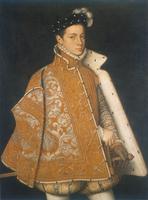
A portrait of a young Alessandro Farnese, the future Duke of Parma
Sofonisba Anguissola
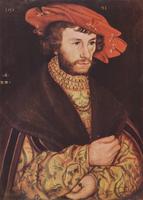
Portrait of a young man in hat
Lucas Cranach the Elder
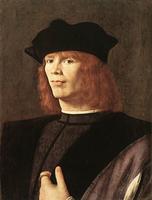
Portrait of a Man
Andrea Solario
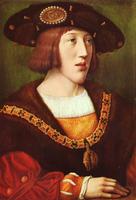
Portrait of Charles V, Holy Roman Emperor
Bernard Van Orley
Portrait of a Bearded Gentleman
Bartolomeo Veneto
Portrait of Henry VIII, King of England
Hans Holbein the Younger