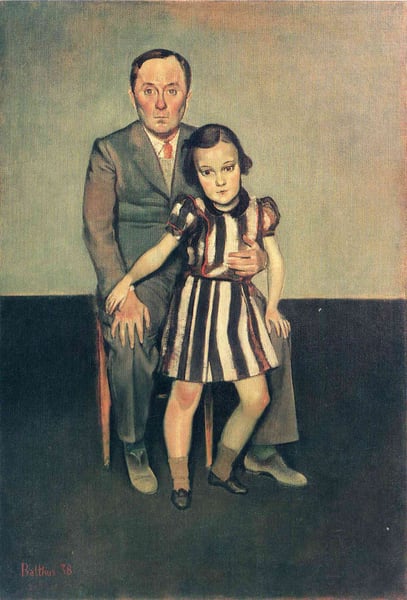
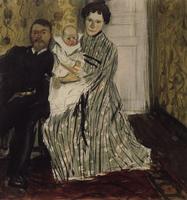
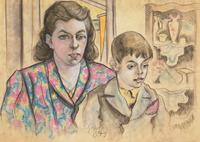
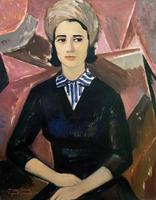
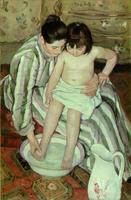
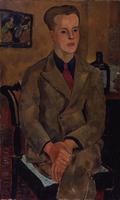
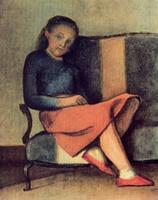
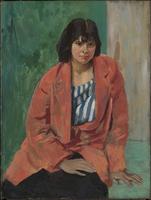
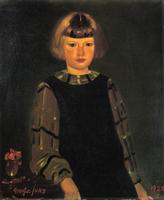
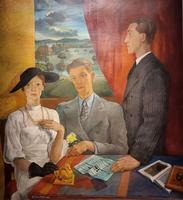
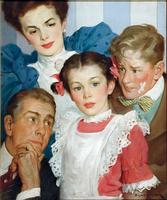
In "Joan Miro and his daughter Dolores," Balthus presents a psychologically charged portrait that bridges the personal and the symbolic within the Expressionist tradition. The work’s significance lies in its depiction of a celebrated Surrealist artist (Miro) in an intimate, familial moment—a subject that contrasts with Miro’s own abstract biomorphism. Balthus employs Expressionist techniques—exaggerated, angular forms, a muted yet tense palette, and a compressed spatial arrangement—to convey the complex emotional dynamics between father and daughter. The figures appear both connected and isolated, their gazes averted, creating a sense of distance that invites reflection on the nature of artistic legacy and domestic intimacy. This portrait is a rare intersection of two major 20th-century artists, rendered with the unsettling stillness characteristic of Balthus, making it a compelling study of personality, portraiture, and the hidden narratives within everyday poses.