Expertenanalyse zu Konstantin Makovskys Two Breton Women
Stil: Realism · Genre: genre painting
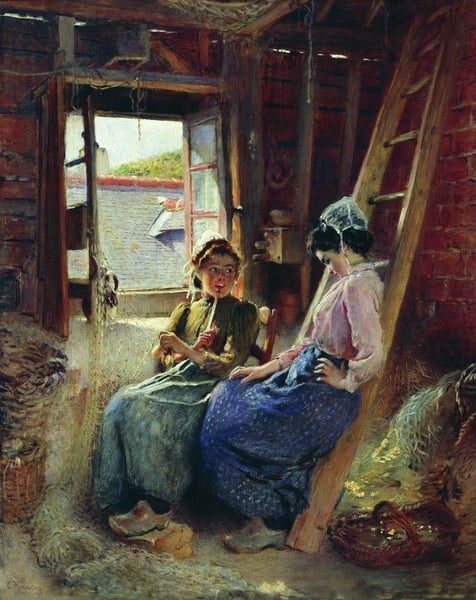
"Two Breton Women" by Konstantin Makovsky stands as a compelling example of how Russian Realism intersected with the broader European fascination for regional identity and ethnographic detail. Painted during the artist's extensive travels in France, the work captures two women from Brittany—a region renowned for its distinctive Celtic heritage, traditional costumes, and strong Catholic faith.
Significance within Realism:
Makovsky brings the core tenets of Realism—truthful observation, everyday subject matter, and meticulous attention to material culture—to a scene that is both intimate and culturally specific. The artist avoids idealization or narrative drama, instead focusing on the quiet dignity of the women’s faces, the tactile quality of their headdresses (coiffes), and the rich texture of their dark woolen garments. This is not a picturesque tourist view but a sincere portrait of real people, rooted in the Realist commitment to documenting life as it is lived.
Significance as a Genre Painting:
Within the genre painting tradition, "Two Breton Women" elevates a mundane moment—perhaps a pause in work or a conversation—into a study of character and place. The women’s expressions convey a reserved solemnity, reflecting the harshness of coastal life and the resilience of a community shaped by isolation and tradition. Makovsky’s brushwork is both precise and atmospheric, grounding the figures in a specific locale while allowing their humanity to transcend time and geography.
Broader Art Historical Context:
Makovsky, though Russian, was deeply influenced by Western European painting and the rise of nationalist schools. In this work, he bridges the gap between the Peredvizhniki (The Wanderers) emphasis on social realism and the French interest in regionalism seen in artists like Jules Breton or Jean-François Millet. By choosing Breton subjects, Makovsky also participates in the 19th-century Romantic-nationalist movement that sought to preserve vanishing folk traditions before industrialization erased them.
In sum, "Two Breton Women" is significant not only for its technical mastery—especially in rendering fabric and light—but also for its role in expanding Realist genre painting beyond the artist’s native Russia, proving that the movement’s core values of truth and empathy could resonate across cultures.
Museum / Gallery
Visuell ähnlich
20 Werke mit ähnlicher Komposition und Farbpalette
The letter
Edward Portielje
Two Women Comparing Shopping
Edward Portielje
Flirtation
Giovanni Battista Torriglia
Two Zeelandic girls in an interior
Edward Portielje
The fisherman's family
Alessandro Milesi
L'heure de thé
Edward Portielje
Female Peasant Carding Wool
Camille Pissarro
Young Girl with Her Grandmother
Wenzel Tornøe
The Wool Winders
Giovanni Battista Torriglia
Mending nets
Joaquín Sorolla
Dolly's new hat
Haynes King
A Happy Family
Giovanni Battista Torriglia
Carding Wool
Wenzel Tornøe
Stella and Piero
Vittorio Corcos
A Fisherman's Daughter
Jules Breton
H0014 L04615346
Antonio Zoppi
Courtship
Gerolamo Induno
Young woman peeling apples
Carl Zewy
Country girl leaning against a ladder
Silvestro Lega
A Hardanger interior, young girl knitting
Adolph Tidemand