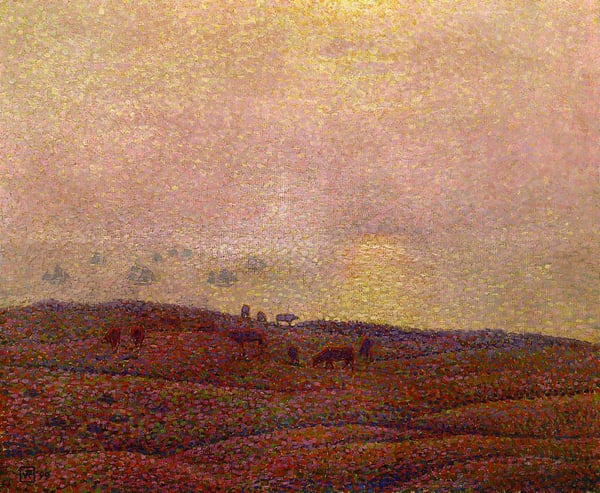
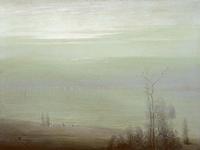
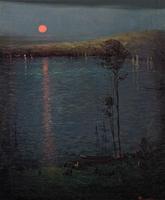
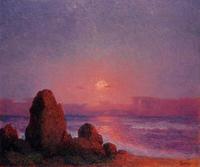
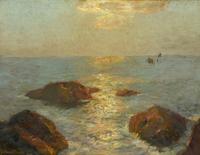
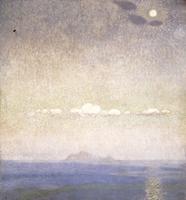
"Cows in a Landscape" by Theo van Rysselberghe exemplifies the meticulous application of Pointillist technique to a pastoral subject, marking a significant contribution to Neo-Impressionism beyond its Parisian origins. As a leading Belgian exponent of the movement, van Rysselberghe adapted Georges Seurat’s scientific color theory—placing tiny, distinct dots of pure pigment—to capture the dappled light and quiet rhythm of rural life. The work’s significance lies in its synthesis of rigorous optical theory with a serene, naturalistic sensibility: the subtle interplay of warm and cool dots models form and atmosphere without dissolving the solidity of the cows or landscape. This approach expanded Neo-Impressionism’s range from urban scenes to bucolic idylls, demonstrating that Pointillism could evoke both sensory vibrancy and tranquil order. Van Rysselberghe’s cohesive composition and luminous palette here underscore his role in making this style a durable, cross-cultural force in late 19th-century European art.