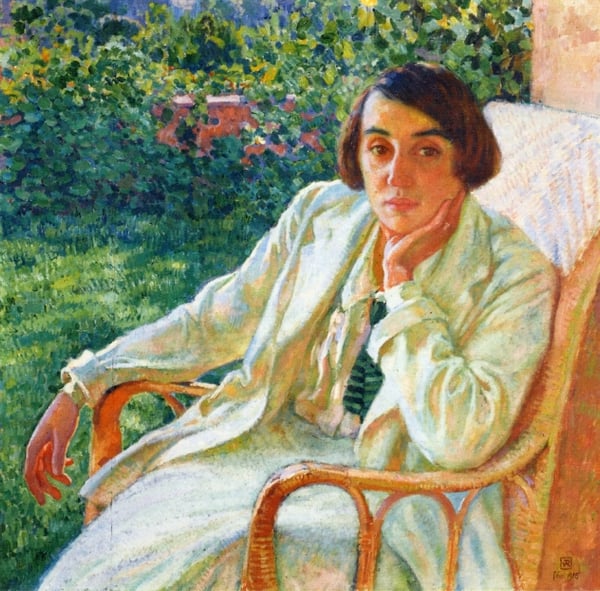
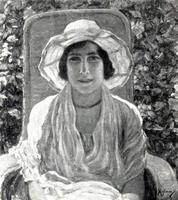
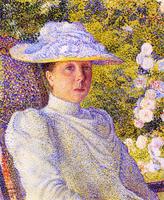
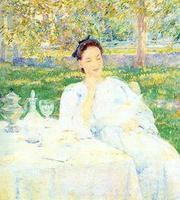
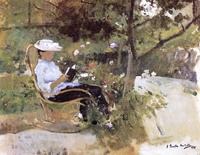
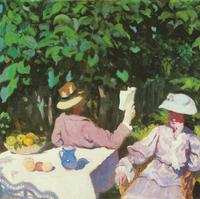
This portrait, "Elizabeth van Rysselberghe in a Cane Chair," is significant within Post-Impressionism for how it channels the movement's broader shift away from strict optical realism toward a more intimate, psychologically resonant depiction of the sitter.
As a Post-Impressionist work by Theo van Rysselberghe, the painting moves beyond the artist’s earlier Neo-Impressionist (pointillist) phase. While still attentive to light and color, the portrait prioritizes a sense of quiet, domestic presence over scientific color theory. The subject—likely the artist’s wife or a close relation—is rendered with a calm directness in the genre of portraiture, emphasizing her individuality and the serene, almost meditative atmosphere of the moment.
The use of a simple cane chair as a compositional anchor is telling: it roots the figure in everyday life, a hallmark of Post-Impressionist portraiture that sought to capture modern, unidealized subjects. Van Rysselberghe’s handling likely softens contours and modulates color to express mood rather than mere visual accuracy, placing this work within the movement’s broader exploration of subjective emotion and formal harmony. The portrait thus stands as a refined example of how Post-Impressionist artists transformed portrait conventions into vehicles for psychological depth and decorative beauty.