Theo van Rysselberghe の Garden with Villa and Fountain の専門的な分析
スタイル:Post-Impressionism · ジャンル:cityscape
Expert Analysis: "Garden with Villa and Fountain" by Theo van Rysselberghe
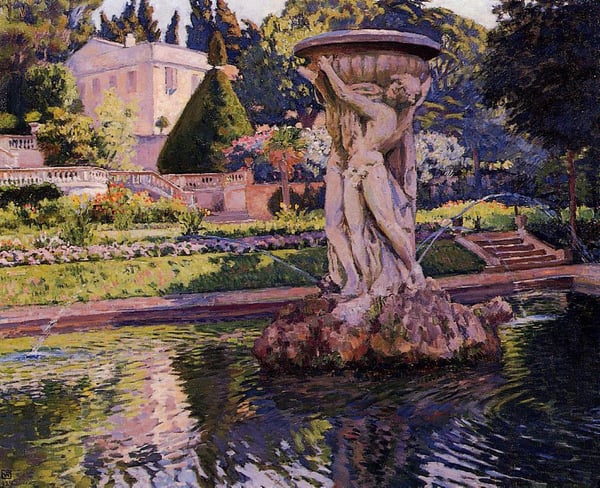
Theo van Rysselberghe’s Garden with Villa and Fountain is a refined Post-Impressionist cityscape that exemplifies the Belgian master’s unique contribution to Neo-Impressionism. While van Rysselberghe is best known for his Pointillist portraits and seascapes, this work demonstrates his ability to apply the systematic color-division technique—pioneered by Georges Seurat—to an urban leisure setting, blending nature and architecture with luminous precision.
Stylistic Significance within Post-Impressionism:
Van Rysselberghe transforms a conventional villa garden into a tapestry of pure, unmodulated dots of color. Instead of relying on line or contour, he builds form through the optical mixing of complementary hues (e.g., warm oranges in the fountain’s spray juxtaposed with cool violets in the surrounding foliage). This method captures the flickering light of a sun-drenched afternoon, while the rigid grid of the villa’s windows and walls provides a geometric counterpoint—a hallmark of Post-Impressionist structure over Impressionist spontaneity.
Thematic and Genre Innovation:
Although categorized as a cityscape, the composition blurs the boundary between the cultivated garden (nature) and the bourgeois villa (urbanity). The fountain acts as a central axis, its rhythmic water jets echoing the repetitive strokes of the painting’s surface. This infusion of contemporary leisure—a private garden as a retreat from industrialization—is a distinctly modern subject, reflective of the Belle Époque’s fascination with outdoor recreation and domestic elegance.
Art Historical Context:
Van Rysselberghe was a leading figure in Les XX, a progressive Brussels-based avant-garde group. This work embodies the group’s commitment to fusing scientific color theory with emotional resonance. Unlike Seurat’s detached urban scenes or Signac’s marine landscapes, van Rysselberghe’s garden feels intimate yet precise—a personal vision of harmony between man-made order and natural vitality. The villa’s clean lines anticipate aspects of Art Nouveau, while the pointillist technique roots the piece firmly in Neo-Impressionist exploration.
Conclusion:
Garden with Villa and Fountain is significant for its successful synthesis of Pointillist technique with a cityscape genre, proving that Neo-Impressionism was not limited to pastoral or coastal scenes. It stands as a testament to van Rysselberghe’s ability to render modern life through the lens of optical science, making it a key work in the evolution of Post-Impressionist urban representation.
Museum / Gallery
視覚的に類似
構図やパレットが近い作品 20 件
Maria looking at the fish
Joaquín Sorolla
An Italian Garden
William Merritt Chase
Gardens of La Granja
Joaquín Sorolla
Statue of Daphne
John Singer Sargent
Watching the Fish
Joaquín Sorolla
Villa de Marlia. A Fountain
John Singer Sargent
'Souvenir du jardin estival'
Diana Malivani
Scheiber Hugó, Kert Kuttal
Scheiber Hugó
Villa di Marlia: Lucca
John Singer Sargent
Terrace at the Mall, Cantral Park
William Merritt Chase
Fountain in Marquayrol
Henri Martin
Terrace overlooking the flower garden in Wannsee
Max Liebermann
Fountain in the Park Marquayro
Henri Martin
Florence Fountain, Boboli Gardens
John Singer Sargent
Versailles. "Mirror" at Trianon
Alexandre Benois
Garden of Carlos V in the Alcázar, Seville
Joaquín Sorolla
Garden View
Lili Elbe
Fountain in Marquayrol
Henri Martin
Girl in the Garden
Eugène Grasset
Garden with woodland
Cuno Amiet