Theo van Rysselberghe の Large Tree near the Sea の専門的な分析
スタイル:Pointillism, Neo-Impressionism · ジャンル:landscape
Expert Analysis: "Large Tree near the Sea" by Theo van Rysselberghe
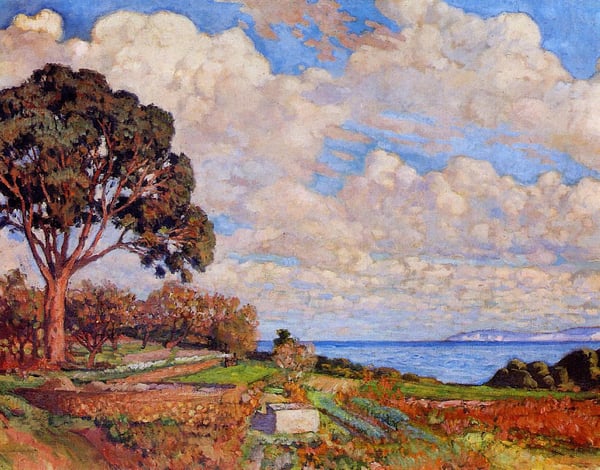
Theo van Rysselberghe’s Large Tree near the Sea stands as a masterful example of Neo-Impressionist landscape painting, demonstrating the artist’s unique synthesis of rigorous pointillist technique with a deeply atmospheric, naturalistic sensibility. While rooted in Georges Seurat’s scientific approach to color division, van Rysselberghe pushes the style toward a more lyrical and expressive rendering of light and environment.
Significance within Pointillism and Neo-Impressionism
-
Harmony of Structure and Atmosphere: The composition centers on a monumental, gnarled tree, its trunk and branches forming a powerful vertical anchor against the horizontal expanse of sea and sky. This structural tension—between the organic, irregular form of the tree and the orderly, stippled fields of color—is a hallmark of van Rysselberghe’s mature work. He avoids the static, geometric quality sometimes found in earlier pointillist works, instead using the repeated dots to create a vibrant, shimmering surface that captures the breezy movement of foliage and the play of sunlight on water.
-
Luminosity via Color Theory: Van Rysselberghe employs a refined divisionist palette: pure touches of complementary blues, oranges, and greens are placed side by side to be optically mixed by the viewer. The sea’s deep ultramarine is punctuated by tiny flecks of pale yellow and rose, evoking the glitter of midday sun. The tree’s shadowed underside is built from violet and emerald dots, while its sunlit side glows with cadmium yellow and orange. This meticulous application generates an almost palpable sense of Mediterranean heat and coastal air—a departure from the cooler, more intellectual color schemes of the Parisian Neo-Impressionists.
-
Monumentality Meets Transience: The “large tree” is depicted not merely as a botanical specimen but as a timeless witness to the changing sea and sky. Van Rysselberghe’s choice to elevate the tree to the picture’s central motif—a subject more typical of Romantic or Symbolist painting—demonstrates Neo-Impressionism’s capacity to blend scientific technique with poetic, almost philosophical contemplation. The tree’s solid, earth-bound presence contrasts with the fluid, ever-shifting dots of the maritime background, emphasizing the tension between permanence and flux.
Art Historical Context
As a leading figure of the Belgian avant-garde and a founding member of Les XX, van Rysselberghe was instrumental in spreading Pointillism beyond France. Large Tree near the Sea exemplifies how he adapted the technique to his own expressive ends—less dogmatic than Seurat, more painterly than Signac. The work is significant for showing that Neo-Impressionism was not a rigid system but a flexible language capable of rendering both intimacy and grandeur. In this piece, the controlled dot becomes a vehicle for visceral atmosphere, marking van Rysselberghe’s pivotal role in the evolution of modern landscape painting.
Museum / Gallery
視覚的に類似
構図やパレットが近い作品 20 件
Sunset at Montmajour
Vincent van Gogh
The Fields
Alfred Sisley
The Coast of Varengeville
Claude Monet
Landscape of Corsica
Henri Matisse
View Of Méréville
Maximilien Luce
Woodside Pastoral
Horace Trenerry
Monsieur Maufra's Garden by the Sea
Maxime Maufra
The Plain of Veneux, View of Sablons
Alfred Sisley
Near the Bank of the Seine at By
Alfred Sisley
September Morning
Alfred Sisley
The valley of the Oise
Paul Cezanne
Landscape with Dunes
Vincent van Gogh
Landscape with a Man Digging
Camille Pissarro
Resting in the woods Pontoise
Camille Pissarro
The Farmer's Lawn
Julian Alden Weir
On the Cliff at Fecamp
Claude Monet
House with Red Roof
Georges Seurat
Corsican Landscape
Henri Matisse
Pommiers en fleurs
Armand Guillaumin
Last Rays
Konstantin Bogaevsky