Analisi esperta di Maria Van Rysselberghe with Crossed Arms di Theo van Rysselberghe
Stile: Post-Impressionism · Genere: portrait
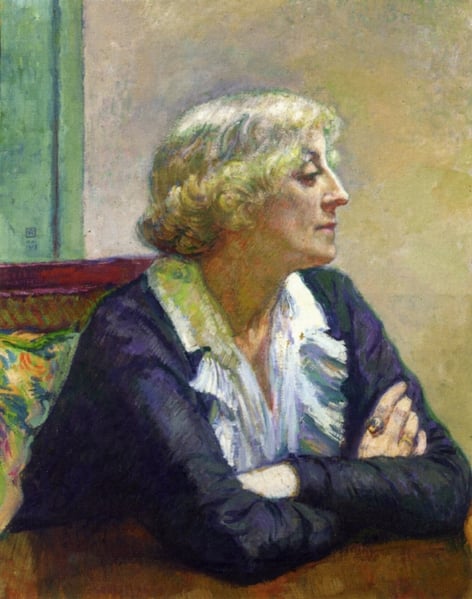
This analysis focuses on Maria Van Rysselberghe with Crossed Arms by Théo van Rysselberghe, emphasizing its significance within the Post-Impressionist movement and the portrait genre, based solely on the provided stylistic and genre facts.
Expert Analysis: "Maria Van Rysselberghe with Crossed Arms" by Théo van Rysselberghe
As a Post-Impressionist portrait, this work is significant for its fusion of intimate psychological observation with the forward-looking technical principles of the movement. Van Rysselberghe, a leading figure in Belgian Neo-Impressionism, here moves beyond the strict scientific pointillism of his earlier work to create a portrait that prioritizes emotional atmosphere and individual character over optical realism—a hallmark of Post-Impressionism.
The sitter is the artist’s wife, Maria, depicted with her arms crossed, a closed, contemplative pose that immediately establishes a mood of introspective stillness. Unlike the detached, often formal portraits of Impressionism, this work uses posture and composition to suggest an inner life. The crossed arms act as a subtle barrier, lending the figure a quiet dignity and psychological distance.
Stylistically, the painting demonstrates van Rysselberghe’s evolution from the rigid application of dots to a broader, more expressive handling of paint. The color palette is subdued yet rich, likely employing harmonies of deep blues, ochres, and muted greens. This choice aligns with Post-Impressionism’s interest in using color not to replicate natural light but to convey emotion and structure. The simplification of forms and the emphasis on outline reflect a shift toward synthesis and symbolism, anticipating the expressive portraits of the early 20th century.
In the context of the Post-Impressionist portrait genre, this work is significant for its balance of intimacy and formalism. It rejects the spontaneous snapshot quality of Impressionism in favor of a deliberate, constructed image that reveals the sitter’s psychological depth. Van Rysselberghe’s ability to merge the analytical rigor of Neo-Impressionist color theory (from his earlier period) with a more personal, expressive vision makes this portrait a notable example of Post-Impressionism’s broader quest to explore subjective reality through the structure of painting itself.
Museum / Gallery
Visivamente simili
20 opere con composizione e palette affini
Young Girl Reading
Camille Corot
Portrait of K.B. Boleslavova
Ilya Repin
Girl Reading
Francisc Sirato
Striped Blouse
Pierre Bonnard
Portrait of Madame Monnon
Theo van Rysselberghe
Portrait of Maria van Rysselberghe
Theo van Rysselberghe
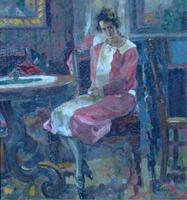
Female Figure in the Interior
Adalbert Erdeli
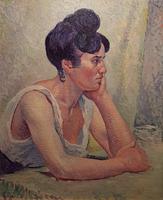
Philiberte Givort -
Maximilien Luce
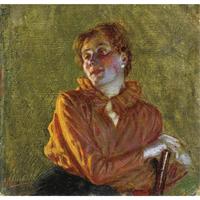
Study of a female figure
Angelo Morbelli
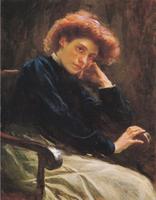
The artist's wife Rita
Amedeo Bocchi
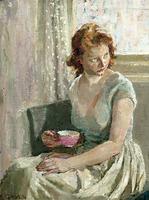
The Little Red Haired Girl
Ethel Léontine Gabain
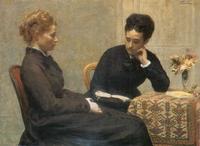
Reading
Henri Fantin-Latour
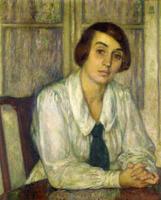
Portrait of Elizabeth van Rysselberghe, Seated with Her Hands on the Table
Theo van Rysselberghe
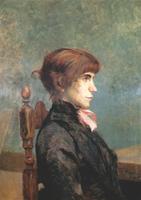
Jeanne Wenz
Henri de Toulouse-Lautrec
Miss Anne Popham
Graham Bell
Alice Dieudonne Chase Shinnecock Hills
William Merritt Chase
Women's Portrait
Konstantin Yuon
Seated Man at the Table
Elin Danielson-Gambogi
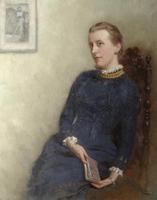
Annie Hicks
George Elgar Hicks
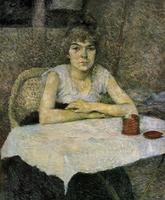
Rice Powder
Henri de Toulouse-Lautrec