Analisi esperta di Moroccan Butcher Shop di Theo van Rysselberghe
Stile: Impressionism, Realism · Genere: genre painting
Expert Analysis: "Moroccan Butcher Shop" by Theo van Rysselberghe
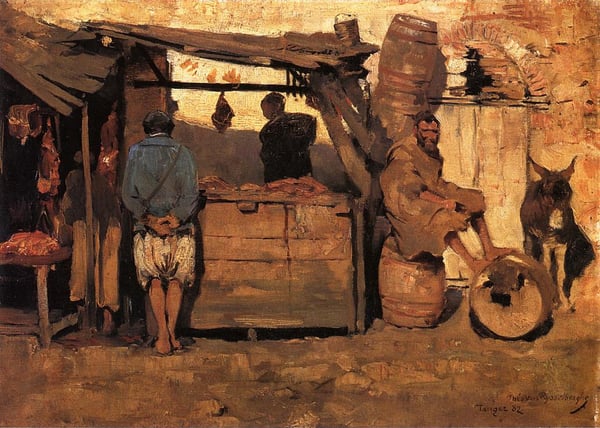
Theo van Rysselberghe’s Moroccan Butcher Shop occupies a singular position at the intersection of Impressionism and Realism, two movements that typically diverged in purpose: Realism sought unvarnished truth in everyday life, while Impressionism prioritized light and color over narrative. This genre painting—a depiction of an ordinary commercial scene—synthesizes both approaches, lending the work its significance.
As a Realist subject, the butcher shop is unidealized: raw meats hang in the foreground, a robed figure attends to a customer, and the space is cluttered with the tools of trade. There is no exoticism or romanticism; instead, van Rysselberghe presents a frank, ethnographic slice of Moroccan life, echoing the social documentation of Courbet or Millet. The choice to focus on a humble, functional space rather than a dramatic or picturesque scene anchors the painting in the Realist tradition of dignifying the everyday.
Yet the handling of the scene is distinctly Impressionist. The brushwork is loose and rapid, capturing the fleeting effects of sunlight filtering through the shop’s entrance and casting dappled shadows across the floor. Color is used not merely for description but for atmospheric vibrancy: warm ochres, muted crimsons, and cool blues interplay, giving the interior a luminous, airy quality. The composition feels instantaneous—a snapshot of a moment, not a staged tableau. This fusion of Realist subject matter (the unvarnished truth of commerce and labor) with Impressionist technique (the sensory experience of light and color) makes the painting remarkable within both styles.
Significantly, van Rysselberghe was a leading figure in the Neo-Impressionist movement, known for pointillism, but this earlier work demonstrates his foundation in more conventional Impressionism and Realism. Moroccan Butcher Shop thus acts as a bridge: it retains the socio‑cultural specificity of Realism while pushing toward the optical innovations that would define his later career. The painting is a testament to how Impressionism could elevate humble genre scenes without losing their documentary power, and how Realism could absorb vibrant, atmospheric color without sacrificing its commitment to truth. In this balance—between the quotidian and the luminous—lies the work’s enduring significance.
Visivamente simili
20 opere con composizione e palette affini
Moroccan Fruit Market
Theo van Rysselberghe
Market Scene in Venice
Alessandro Milesi
Vaszary János, Orosz Fogjok 1915
Vaszary János
Buying a dagger
Konstantin Korovin
On the front door
Romualdo Locatelli
Arab husband
Marià Fortuny
Glimpse of the courtyard
Michele Cammarano
Bird seller
Giacomo Favretto
The knife grinder
Alessandro Milesi
A winepress house of an Italian winecellar
Anton Romako
Moroccan blacksmith
Marià Fortuny
A Flower Stall
John William Waterhouse
Mother Presle, Montfoucault
Camille Pissarro
Farmyard
Alexandre-Gabriel Decamps
Peasant Interior with Woman at a Well
Willem Kalf
Tavern
Andrei Ryabushkin
A day at the market
Albert Chevallier Tayler
Interior of a fisherman's cabin, Galway
Alfred Downing Fripp
The Kitchen
Clara Southern
Life in Venice
Ettore Tito