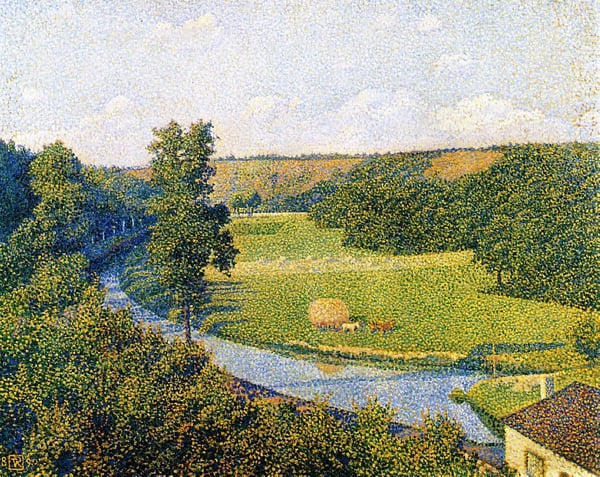
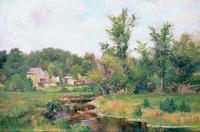
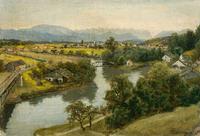
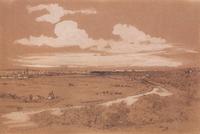
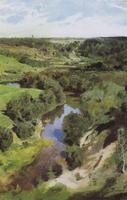
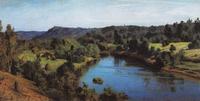
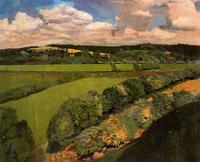
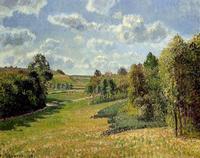
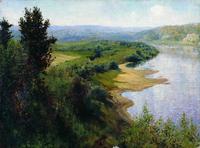
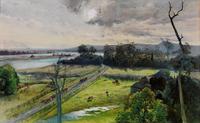
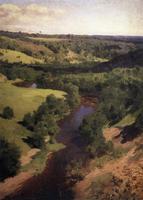
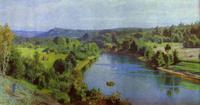
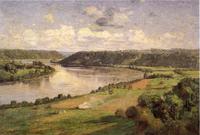
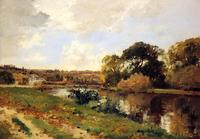
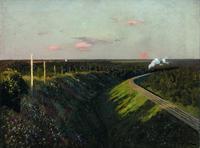
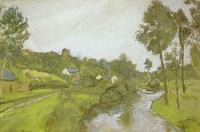
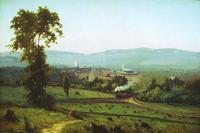
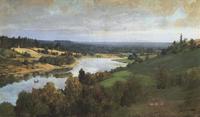
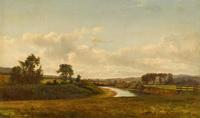
"The Valley of the Sambre" by Theo van Rysselberghe is a quintessential example of Neo-Impressionist landscape painting, executed in the Pointillist technique. The work's significance lies in its rigorous application of the color theory championed by Georges Seurat and Paul Signac, which van Rysselberghe adopted and refined as a leading member of the avant-garde group Les XX. Unlike the more spontaneous brushwork of Impressionism, this landscape is built from meticulously placed dots of pure, unmixed pigment—cool blues and greens for the valley's depth, warm yellows and oranges for sunlit slopes—that optically blend in the viewer's eye to create a vibrant, luminous atmosphere. The subject, the Sambre River valley in Belgium, is transformed into a study of light and atmosphere through systematic divisionism, where each dab of color is carefully chosen to heighten contrasts and harmonies. Van Rysselberghe's personal touch is evident in the subtle modulation of hues, lending the scene a serene, almost meditative quality while demonstrating how Pointillism could capture the fleeting effects of natural light with scientific precision. This artwork thus stands as a testament to the Neo-Impressionist goal of fusing artistic intuition with optical science, marking a pivotal moment in the evolution of modern landscape painting.