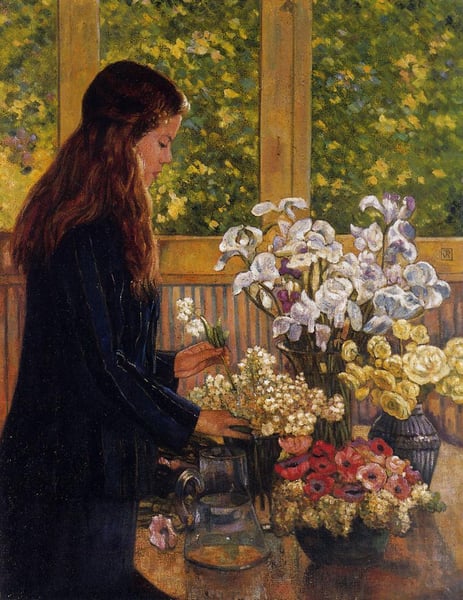
Young Girl with a Vase of Flowers
Expert analysis of Theo van Rysselberghe’s Young Girl with a Vase of Flowers
Style: Post-Impressionism · Genre: portrait
Expert Analysis: "Young Girl with a Vase of Flowers" by Theo van Rysselberghe
Theo van Rysselberghe’s Young Girl with a Vase of Flowers stands as a luminous testament to Post-Impressionism’s capacity to blend rigorous technique with intimate subject matter. As a leading figure of Belgian Neo-Impressionism, van Rysselberghe adapted Georges Seurat’s Pointillist method—applying tiny, distinct dots of pure color—to the portrait genre, achieving a rare synthesis of scientific color theory and psychological warmth.
Significance within Post-Impressionism:
What distinguishes this work is its masterful reconciliation of systematic technique with human presence. While Seurat and Paul Signac often applied Pointillism to landscapes or idealized figures, van Rysselberghe turns the method inward, using fragmented strokes to model the soft flesh of a young girl and the delicate petals of flowers. The result is not cold or mechanical; rather, the optical mixing of hues (e.g., juxtaposed blues and yellows to create vibrant greens) infuses the canvas with light, producing an almost shimmering atmosphere that feels natural and alive.
Composition and Symbolism:
The portrait merges two genres—portraiture and still life—uniting the girl’s contemplative gaze with the floral arrangement. This pairing echoes a broader Post-Impressionist interest in symbolism: the flowers, rendered with the same dotted technique as the girl’s skin, suggest the ephemeral beauty of youth and nature. The vase becomes a subtle bridge between humanity and the organic world, while the controlled, meticulous dots reflect the artist’s belief that emotion could be distilled through precise optical effects.
Legacy:
Van Rysselberghe’s work demonstrates that Neo-Impressionism was not a rigid dogma but a flexible language. Young Girl with a Vase of Flowers shows how Pointillism could be harnessed for portraiture—a genre often dominated by broader, looser strokes—challenging the notion that dots were solely for landscapes. The painting remains a key example of how Post-Impressionist artists pushed impressionism’s fleeting effects toward structural rigor without sacrificing tenderness.
Museum / Gallery
Visually similar
20 works with related composition and palette
Irysy
Czesław Jan Pyrgies
Fleur-De-LIs
Robert Lewis Reid
Peonies and Iris
Louis Comfort Tiffany
Irysy Liliowe
Czesław Jan Pyrgies
Irysy
Czesław Jan Pyrgies
Woman on a Porch with Flowers
Robert Lewis Reid
Iris
Roderic O'Conor
Flowers and Wilhelmine
Lovis Corinth
Flowers in Vase
Ibrahim Calli
Figure through flowers
Grace Cossington Smith
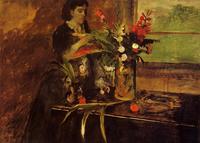
Portrait of Mme. Rene De Gas, born Estelle Musson
Edgar Degas
Rose with Purple Iris, Garden at Petit Gennevilliers
Gustave Caillebotte
In the Garden
Le Pho
Still Life with Spring Flowers
Jan Sluyters
Irises and poppies
Martiros Sarian
Afternoon in the Garden
Le Pho
A Vase of Irises on the Terrace
Louise Abbéma
Mixed flowers in a porcelain vase
Gregoire Boonzaier
Bouquet of flowers. Peonies, irises, lilies
Ilya Mashkov
White asters
Albert Herter