
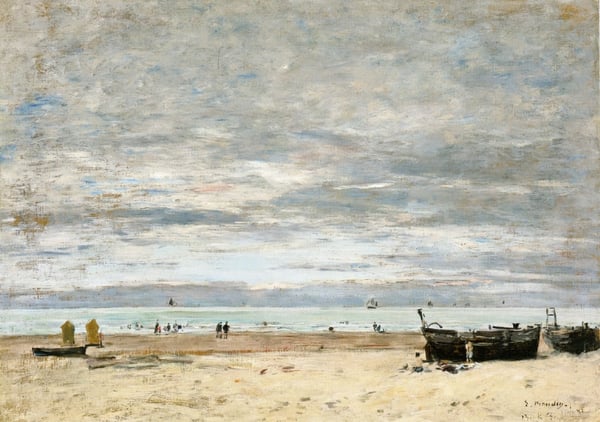
Expertenanalyse zu Eugene Boudins Berck, The Beach at Low Tide
Stil: Impressionism · Genre: landscape
Expert Analysis: Eugene Boudin’s Berck, The Beach at Low Tide
Eugène Boudin’s Berck, The Beach at Low Tide stands as a pivotal work within the early Impressionist movement, offering a masterclass in the observation of transient light and atmospheric conditions. As a landscape painting, it exemplifies Boudin’s lifelong fascination with the sea and sky—a theme that would profoundly influence his protégé, Claude Monet, and the broader Impressionist revolution.
Significance within Impressionism
Boudin is often hailed as a “king of the skies,” and this work showcases his radical departure from academic conventions. Instead of a static, idealized seascape, he captures the fleeting moment of low tide at Berck, a coastal town in northern France. The composition emphasizes the vast, shifting sky—filled with soft, layered clouds—while the sandy foreground and receding water create a delicate balance of horizontals. Boudin’s loose, rapid brushwork and his use of a light, high-key palette (lavenders, pale blues, warm ochres) anticipate the Impressionist focus on plein air immediacy and sensory perception.
Genre and Innovation
As a landscape, the painting transcends mere topography. Boudin treats the beach as a stage for the interplay of light and atmosphere: the wet sand mirrors the sky, the distant horizon dissolves into haze, and the scattered figures (barely suggested) ground the scene in contemporary leisure. This integration of human presence into a natural setting—without narrative or moralizing—was a hallmark of Impressionist modernity.
Why It Matters
Berck, The Beach at Low Tide is significant because it captures a specific, transient condition (low tide) with unprecedented fidelity to optical experience. Boudin’s willingness to paint “only the moment,” as he described it, helped liberate landscape painting from studio artifice. The work thus occupies a crucial bridge between the Realism of Corot and the fully realized Impressionism of Monet’s Impression, Sunrise. In Boudin’s hands, the everyday beach becomes a laboratory for capturing the ephemeral—and a quiet manifesto for the new art.
Museum / Gallery
Visuell ähnlich
20 Werke mit ähnlicher Komposition und Farbpalette
The Calm Sea
Gustave Courbet
The Coastline at Berck at Low Tide
Eugene Boudin
Gray Day, Jersey Coast
John French Sloan
The Beach, Sunset
Gustave Courbet
The Shores of Sainte Adresse at Twilight
Eugene Boudin
The Beach, Berck
Eugene Boudin
Blue and Silver Trouville
James McNeill Whistler
Rocks with Shrimp Fishermen
Pierre-Auguste Renoir
Blue and Silver: Boat Entering Pourville
James McNeill Whistler
Solent Angler
Richard Eurich
Skagen
Peder Severin Kroyer
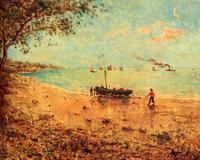
A Beach In Normandy
Alfred Stevens
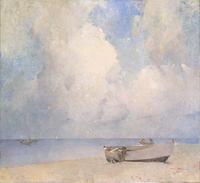
The South Strand
Emil Carlsen
Delaware River Scene
Thomas Eakins
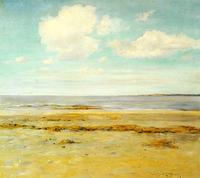
The Deserted Beach
William Merritt Chase
Noordzee met bootjes en duinen
Louis Artan

Yurievets. Gloomy Day on the Volga.
Isaac Levitan

On the Beach
Eugene Boudin
The Angry Sea
James McNeill Whistler
The Tourgeville Shores
Eugene Boudin