Eugene Boudin の Deauville: Beach Scene の専門的な分析
スタイル:Impressionism · ジャンル:genre painting
Expert Analysis: "Deauville: Beach Scene" by Eugène Boudin
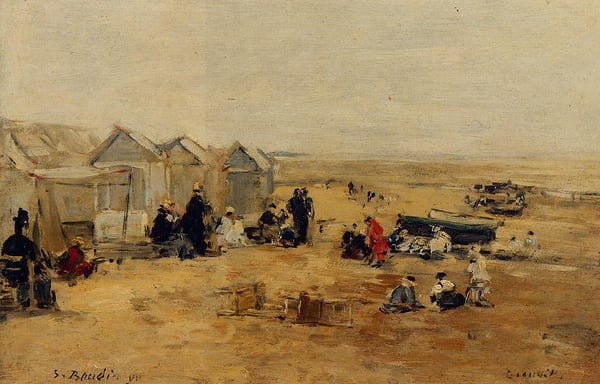
Eugène Boudin’s Deauville: Beach Scene stands as a pivotal work within the early development of Impressionism, bridging the meticulous observation of nature with the fleeting, atmospheric effects that would define the movement. Painted in the 1860s—a decade before the first Impressionist exhibition—this genre scene captures the fashionable seaside resort of Deauville, a favorite destination of the Parisian bourgeoisie.
Significance within Impressionism and the Artist’s Oeuvre
Boudin is often hailed as a "king of the skies" and a direct precursor to Claude Monet, whom he famously encouraged to paint outdoors (en plein air). In this work, his significance lies in two key aspects:
-
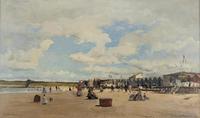
Atmospheric Transience: Boudin’s primary achievement is his rendering of the sky and sea as living, breathing elements. The vast, cloud-filled sky occupies nearly half the canvas, with delicate gradations of blue, gray, and white that suggest shifting weather and light. The shimmering horizon line dissolves into soft haze, a technique that prefigures the Impressionists’ focus on the effects of light rather than solid form.
-
Modern Social Observation: Unlike earlier pastoral or historical subjects, Boudin’s beach scenes document a new, modern leisure class. Elegantly dressed women in crinolines, children playing, and gentlemen strolling along the shore are depicted with quick, loose brushstrokes that capture their casual movements. This focus on contemporary life—rather than myth or history—aligns directly with the Impressionist rejection of academic convention.
Technical and Stylistic Hallmarks
- Brushwork: Boudin employs a rapid, broken touch for the figures and foreground, while the sky and sea are built with broader, more fluid strokes. This variation creates a sense of space and motion, letting the eye drift from the detailed beachgoers to the expansive natural backdrop.
- Palette: Muted earth tones for the sand and clothing contrast with the luminous, pastel-infused sky. The white highlights on the waves and parasols catch the eye, reflecting the actual play of sunlight on surfaces.
- Composition: A low horizon line emphasizes the sky, while the diagonal sweep of the shore guides the viewer’s gaze into the distance—a compositional device Boudin perfected to suggest infinite space and the fleeting moment.
Legacy
Deauville: Beach Scene is more than a charming seaside snapshot; it is a manifesto of the Impressionist ethos. Boudin’s ability to synthesize social observation with atmospheric immediacy directly influenced Monet’s own Terrace at Sainte-Adresse and later Impressionist beach scenes. The painting exemplifies how Boudin transformed the humble genre painting into a vehicle for capturing the ephemeral beauty of modern life—a core goal of the Impressionist movement.
Museum / Gallery
視覚的に類似
構図やパレットが近い作品 20 件
Strand in Trouville
Eugene Boudin
At the beach
Pericles Pantazis
Beach Scene
Eugene Boudin
Trouville, Beach Scene
Eugene Boudin
The Beach at Dinard
Clarence Gagnon
On the Beach
Eugene Boudin
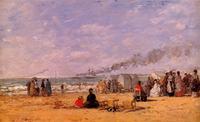
The Beach at Trouville
Eugene Boudin
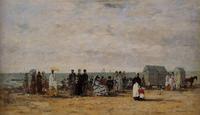
Beach scene
Eugene Boudin
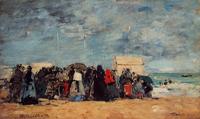
Trouville, Beach Scene
Eugene Boudin
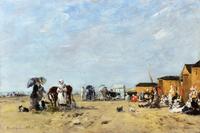
Berck, the Beach
Eugene Boudin
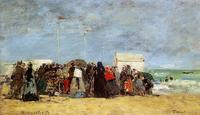
Beach Scene, Trouville
Eugene Boudin
Bathing Tents, St. Malo
Maurice Prendergast
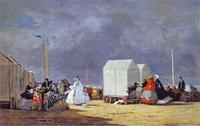
Approaching Storm
Eugene Boudin
Women Fishing for Shrimp at Kerhor
Eugene Boudin
Trouville, Beach Scene
Eugene Boudin
The beach at Trouville
Eugene Boudin
Beach Scene
Eugene Boudin
Bathing time at Deauville
Eugene Boudin
Vue de la plage de Pontaillac à Royan
Emmanuel Lansyer
Women on the Beach, Rough Seas
Eugene Boudin