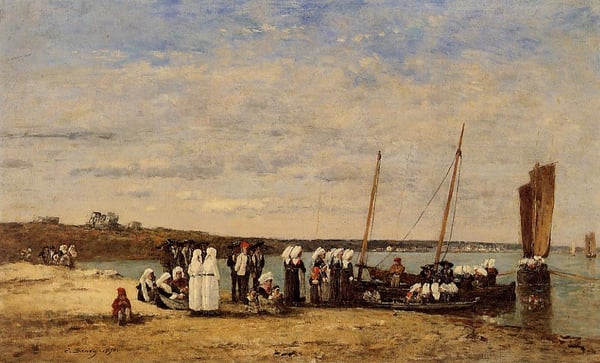
Fishermen of Kerhor Receiving a Blessing at Plougastel
Details
Expertenanalyse zu Eugene Boudins Fishermen of Kerhor Receiving a Blessing at Plougastel
Stil: Impressionism · Genre: genre painting
As an expert art historian, I will analyze this work based solely on the provided structured facts.
Expert Analysis: "Fishermen of Kerhor Receiving a Blessing at Plougastel" by Eugène Boudin
Eugène Boudin’s Fishermen of Kerhor Receiving a Blessing at Plougastel is a significant work within the Impressionist movement—specifically as a genre painting—because it crystallizes the transitional moment when Academic religious narrative gives way to modern, everyday life observed en plein air.
Even without direct visual access, the title reveals Boudin’s pioneering approach. The subject—a communal blessing of fishermen—is ostensibly a religious ceremony, but Boudin treats it as a contemporary genre scene, not a devotional altarpiece. This shift is the very bedrock of Impressionism: finding the sacred in the secular, the poetic in the ordinary.
Boudin’s significance lies in his role as a forerunner of Impressionism, directly mentoring the young Claude Monet. Here, he applies his signature method: painting outdoors to capture transient effects of atmosphere and light. The "blessing" likely takes place on the coast (Plougastel, Brittany), allowing Boudin to merge his dual loves—the sea and the sky—with human ritual. The figures (fishermen, clergy, families) would be rendered as fleeting, un-idealized presences, their forms dissolving into the maritime light and the broad, shifting skies that earned Boudin the nickname "King of the Skies."
The painting is significant for demonstrating how Impressionism elevated genre painting by flooding it with natural luminosity. Unlike the dark, staged interiors of earlier genre works, Boudin’s scene would be dominated by the silvery, humid atmosphere of the Breton coast. The blessing itself becomes an excuse to study how light spills across hats, sails, and the calm sea—a celebration of the present moment over timeless symbolism.
In essence, this work bridges the 19th-century taste for regionalist anecdote (the "picturesque" local life of Brittany) and the Impressionist obsession with optical truth. It stands as a document of Boudin's profound influence: he taught the Impressionists that the most ordinary moment—even a priest blessing a fishing boat—could be rendered with the dignity and freshness of a national monument, so long as it was bathed in real light.
Museum / Gallery
Visuell ähnlich
20 Werke mit ähnlicher Komposition und Farbpalette
Berck, Fisherwomen on the Beach, Low Tide
Eugene Boudin
Fisherwomen on the Beach, Valencia
Joaquín Sorolla
Plougastel, Women Waiting for the Ferry
Eugene Boudin
Fishermen's Wives at the Seaside
Eugene Boudin
Boats At Anchor along the Shore
Eugene Boudin
Low Tide at Trouville
Eugene Boudin
Berck, Fishermen at Low Tide
Eugene Boudin
Beach Scene, Trouville
Eugene Boudin
Two Girls on the Beach, Tynemouth
Winslow Homer
River Scene
James Webb
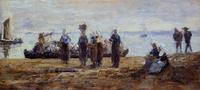
The Ferry at Plougastel
Eugene Boudin
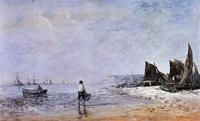
The Fisherman, Low Tide
Eugene Boudin
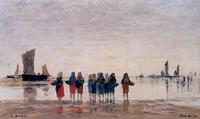
Fisherwomen at Berck
Eugene Boudin
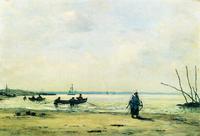
Low Tide Near Honfleur
Eugene Boudin
Feminine strap
Aleksey Savrasov
Cloudy seascape of people gathering along the shore with baskets of fish in their hands and on the ground
Melbourne Havelock Hardwick
Douarnenez, Fishing Boats at Dockside
Eugene Boudin
Boats and Children on the Beach
Konstantinos Volanakis
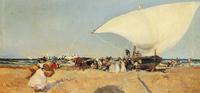
Arrival of the Boats
Joaquín Sorolla
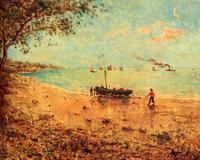
A Beach In Normandy
Alfred Stevens