Expertenanalyse zu Eugene Boudins Harnessed Horses
Stil: Impressionism · Genre: animal painting
Expert Analysis of "Harnessed Horses" by Eugène Boudin
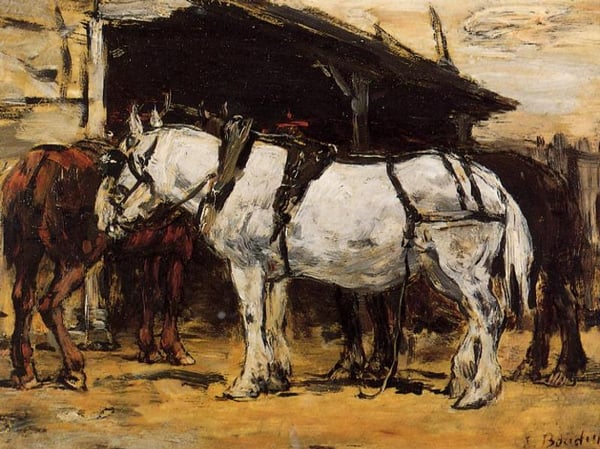
Eugène Boudin’s Harnessed Horses occupies a notable place within the Impressionist movement, not only because of its subject matter but also because of how it exemplifies the shift toward capturing transient moments of modern life. Although Boudin is best remembered for his luminous seascapes and expansive skies—works that directly influenced Claude Monet—this animal painting demonstrates his broader interest in the interplay of light, atmosphere, and everyday activity.
Significance within Impressionism and Genre
As an Impressionist work, Harnessed Horses reflects the movement’s core commitment to painting en plein air and recording the immediate visual effects of natural light. Boudin applies this sensibility to an animal subject, a genre that traditionally might have been treated with static, academic precision. Instead, he focuses on the harnessed horses as part of a living, breathing scene. The harness itself—a utilitarian object—becomes a device for exploring how light catches leather and metal, while the horses’ postures suggest a moment of rest or readiness rather than a formal portrait.
Boudin’s choice to depict harnessed horses rather than wild or heroic steeds aligns with Impressionism’s fascination with contemporary, unheroic reality. These are working animals, likely hitched to a carriage or cart, embodying the rhythms of 19th-century rural or suburban life that Boudin frequently observed on the coast of Normandy. The painting thus bridges his celebrated marine scenes and his lesser‑known but equally observant studies of animals in their environments.
Artistic Execution and Legacy
The handling of paint is crucial. Boudin’s brushwork is brisk and broken, especially in the horses’ manes and the surrounding landscape, suggesting dappled light and movement rather than meticulous detail. This technique prefigures the fully developed Impressionist style of the 1870s and 1880s. Moreover, the painting’s focus on an animal in harness—a symbol of human utility and transport—ties it to the broader Impressionist interest in depicting the fleeting intersections of people, animals, and nature.
While Harnessed Horses may not be as famous as Boudin’s beach scenes, it is significant as a reminder that Impressionism’s revolution extended to all genres. Boudin’s ability to infuse an animal painting with atmospheric vitality and a sense of passing time marks the work as a meaningful contribution to the movement’s legacy.
Visuell ähnlich
20 Werke mit ähnlicher Komposition und Farbpalette
Work Horses
Cornelis Vreedenburgh
Horse
James Charles
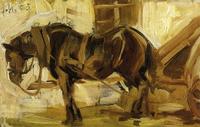
Small Horse Study
Franz Marc
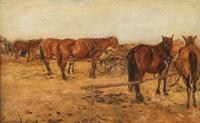
Unhitched horses and wagons
August von Pettenkofen
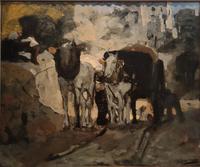
Workhorses in Montmartre
G H Breitner
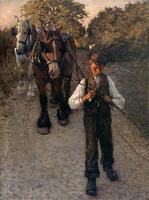
The Plough Boy
Henry Herbert La Thangue
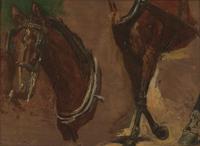
Study for the Fairman Rogers Four in Hand
Thomas Eakins
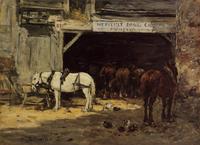
Horses for Hire in a Yard
Eugene Boudin
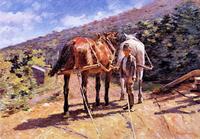
On the Tow-path, a Halt
Theodore Robinson
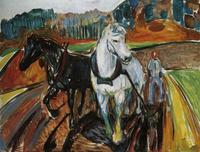
Horse Team
Edvard Munch
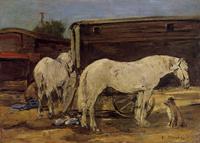
Gypsy Horses
Eugene Boudin
Winter
Karoly Ferenczy
Asiago (Vicenza)
Ettore Tito
Carrying Horse
Ilya Repin
Horse
Tom Scott
Horses Resting
Rudolf Schweitzer-Cumpana
At the ferry
Valentin Serov
Horses in Harness
August von Pettenkofen
Horses in harness
August von Pettenkofen
Heavy Horses Logging
Herman Johannes van der Weele