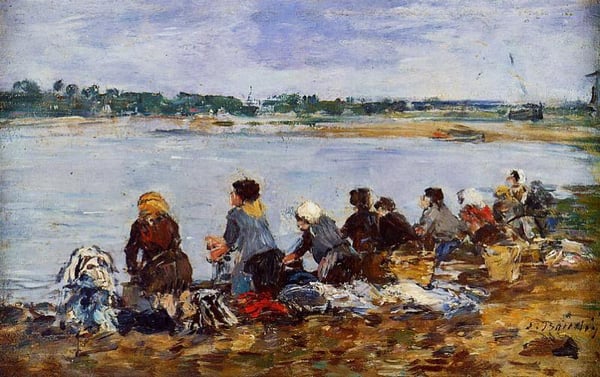
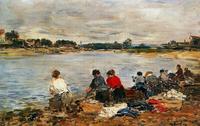
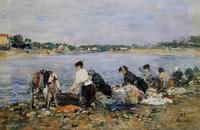
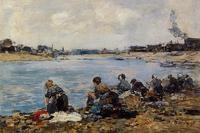
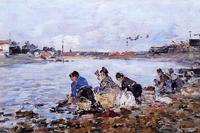
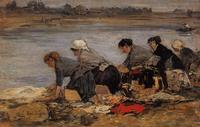
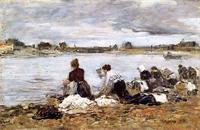
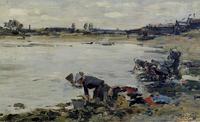
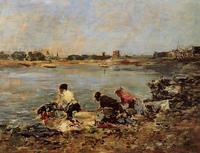
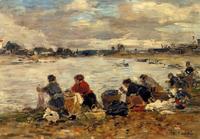
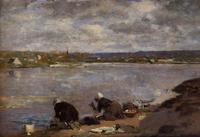
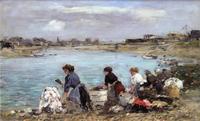
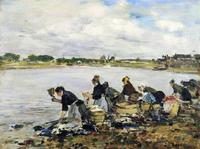
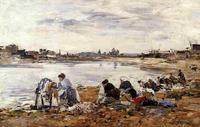
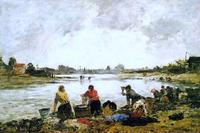
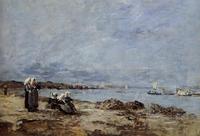
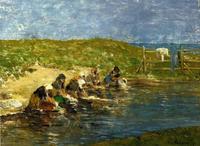
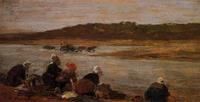
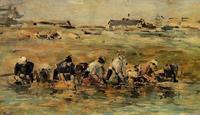
Eugène Boudin’s Laundresses on the Banks of the Touques is a quintessential example of early Impressionism, marking a pivotal shift from studio-bound history painting to the direct observation of modern life. Painted en plein air, the work captures a fleeting moment of everyday labor along the river Touques in Normandy. Boudin’s significance here lies in his revolutionary treatment of light and atmosphere: the sky—dominated by soft, shifting clouds—occupies nearly half the canvas, reflecting his famous dictum that “the sky is the source of light.” The laundresses, rendered with loose, rapid brushstrokes, are integrated into the landscape rather than idealized, embodying the Impressionist focus on ordinary, unheroic subjects. Boudin’s influence on Claude Monet (whom he mentored) is evident in the broken color and shimmering effect of sunlight on water and fabric. This work exemplifies Boudin’s role as a bridge between the Barbizon school’s naturalism and the full-blown Impressionist movement, emphasizing transient effects of weather and light over narrative or moral instruction.