Expert analysis of Eugene Boudin’s The Beach at Trouville
Style: Impressionism · Genre: genre painting
Expert Analysis: "The Beach at Trouville" by Eugène Boudin
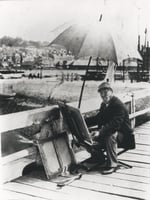
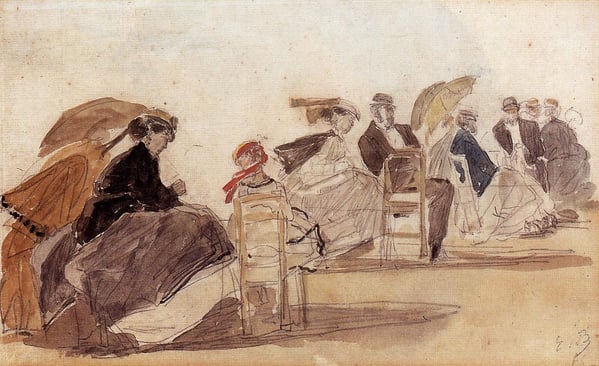
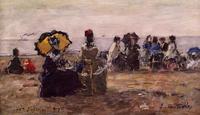
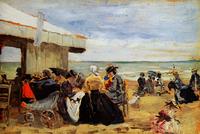
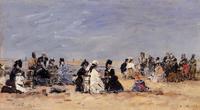
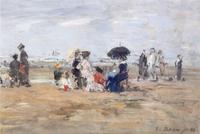
Eugène Boudin’s The Beach at Trouville (c. 1860s–1870s) stands as a pivotal work within the early evolution of Impressionism, bridging the gap between traditional plein-air sketching and the fully realized Impressionist aesthetic. Painted in the fashionable Norman resort of Trouville, the canvas captures a fleeting, sun-drenched moment of bourgeois leisure—a scene of elegantly dressed men and women enjoying the seaside, with parasols, crinolines, and the sea breeze palpable in the brushwork.
Significance within Impressionism and Genre Painting
-
Pioneer of Plein-Air Technique: Boudin was a tireless advocate for painting directly from nature, a practice that would become central to Impressionism. In The Beach at Trouville, he applies quick, broken strokes of white, blue, and grey to render the shifting sky and sparkling water, while the figures are suggested with rapid dabs of pigment—an approach that anticipates Monet’s own beach scenes and the movement’s emphasis on capturing transient atmospheric effects.
-
Subject as Social Document: As a genre painting, the work records a specific cultural phenomenon: the rise of seaside tourism among the French bourgeoisie during the Second Empire. Boudin treats his vacationers not as monumental portraits but as part of a lively, democratic crowd—windblown, relaxed, and absorbed in the momentary pleasure of salt air. This focus on contemporary, everyday leisure aligns with Impressionism’s break from historical or mythological narrative.
-
Mastery of Light and Atmosphere: Boudin was renowned as the “king of skies,” and The Beach at Trouville exemplifies his ability to balance the luminous expanse of the horizon with the animated foreground. The low horizon line and high sky give two-thirds of the canvas to clouds and light, while the beach becomes a stage for shifting shadows and sunlit fabric. This atmospheric sensitivity directly influenced the young Claude Monet, who called Boudin his “master” and credited him with opening his eyes to the fleeting beauty of nature.
-
Color and Economy: Unlike later, more saturated Impressionist palettes, Boudin’s colors here are subdued—soft grays, muted blues, sandy ochres—with accents of black and white in the figures. This restraint emphasizes the hazy coastal light and the unity of the scene, proving that Impressionism’s early breakthroughs came not from bright neon hues but from a refined observation of tonal relationships.
Conclusion
The Beach at Trouville is significant not only as a charming snapshot of 19th-century resort life but as a foundational statement of Impressionist principles. Boudin’s synthesis of plein-air immediacy, social observation, and atmospheric verve makes this painting a crucial precursor to the movement that would revolutionize Western art. It demonstrates that the everyday—the wind, the crowd, the fleeting cloud—could be as worthy of the canvas as the heroic or the timeless.
Museum / Gallery
Visually similar
20 works with related composition and palette
Figures on Beach in front of Bathing Huts
Eugene Boudin
Beach Scene at Trouville
Eugene Boudin
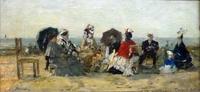
Figures on the beach at Trouville
Eugene Boudin
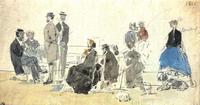
On the Beach
Eugene Boudin
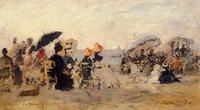
Beach Scene
Eugene Boudin
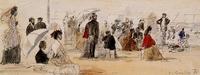
Untitled
Eugene Boudin
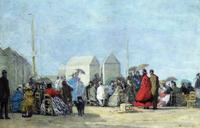
Beach Scene at Trouville
Eugene Boudin
Two Women in a Park
Maurice Prendergast
Trouville
Eugene Boudin
Trouville, on the Beach Sheltered by a Parasol
Eugene Boudin
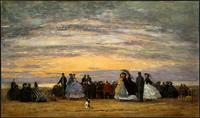
The Beach at Villerville
Eugene Boudin
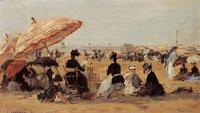
The Beach
Eugene Boudin
Project for Portraits in a Frieze - Three Women
Edgar Degas
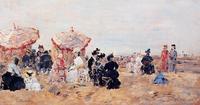
Beach Scene, Villers
Eugene Boudin
Beach Scene, the Yellow Umbrella
Eugene Boudin
A Beach Scene
Eugene Boudin
Ladies Seated on a Bench (also known as Ladies in the Park)
Maurice Prendergast
Beach Scene, Trouville
Eugene Boudin
Trouville, scene on the beach
Eugene Boudin
Two Women with Umbrellas
Pierre-Auguste Renoir