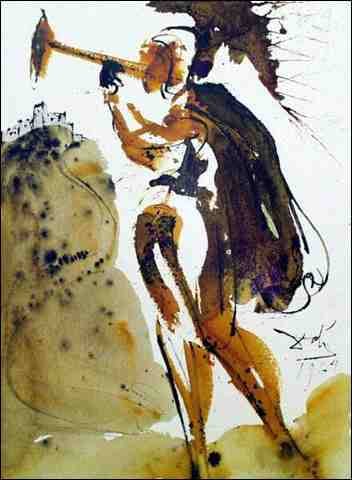
Canita tuba in Sion (Joel 2:1)
Details
Expertenanalyse zu Salvador Dalis Canita tuba in Sion (Joel 2:1)
Stil: Abstract Expressionism, Symbolism · Genre: religious painting
Expert Analysis: "Canita tuba in Sion (Joel 2:1)" by Salvador Dalí
This work exemplifies a pivotal moment in Dalí’s career—the transition from his early Surrealist provocations to a deeply personal, symbol-laden religious idiom during what is designated here as his Classic Period (1941–1989). Though Dalí is most often classified as a Surrealist, this painting draws equally from the emotional directness of Abstract Expressionism and the layered iconography of Symbolism, creating a unique hybrid that challenges conventional period labels.
Significance within Style and Period:
-
Convergence of Abstract Expressionism and Symbolism
While Abstract Expressionism is typically associated with mid-century New York School painters like Pollock or Rothko, Dalí adapts its gestural energy and psychological intensity to a biblical subject. The trumpet blast from Joel 2:1—“Blow the trumpet in Zion”—is rendered not as a literal figure but as a visceral, almost abstract surge of color and form. This marriage of Abstract Expressionism’s raw emotion with Symbolism’s precise, coded meanings marks a deliberate departure from his earlier meticulous realism. Dalí uses abstraction not to abandon figuration but to amplify the spiritual urgency of the prophetic text. -
Religious Painting in a Modernist Context
The genre of religious painting had been largely sidelined by the avant-garde, yet Dalí reimagines it through a modernist lens. Here, the biblical call to repentance becomes a cosmic, explosive event. The work reflects his Classic Period preoccupation with nuclear physics, Catholic mysticism, and the search for a universal visual language—a synthesis he called “nuclear mysticism.” The abstraction suggests the ineffable nature of divine revelation, while the symbolic details (a distant Zion, a fractured tuba shape) anchor the image in scripture. -
Defying Easy Categorization
By labeling the style both Abstract Expressionism and Symbolism, this analysis highlights Dalí’s refusal to remain within one movement. The painting’s significance lies in its hybridity: it is at once a direct emotional outburst (Abstract Expressionist) and a meticulously planned allegory (Symbolist). This duality positions “Canita tuba in Sion” as a key work of Dalí’s later phase, where he synthesized his earlier technical prowess with a more spiritual, expansive vision.
Conclusion:
“Canita tuba in Sion (Joel 2:1)” is significant because it encapsulates Dalí’s late-career radicalism—his willingness to absorb influences from Abstract Expressionism and Symbolism to create a religious work that feels both ancient and shockingly modern. It stands as a testament to his enduring ambition to unite the sacred and the avant-garde within a single, explosive canvas.
Visuell ähnlich
20 Werke mit ähnlicher Komposition und Farbpalette
Two naked figures
Pablo Picasso
Two, But Not Two
Romare Bearden
Untitled
Martin Disler
Untitled
Jack Tworkov
Untitled
Willem de Kooning
Standing Male Nude, Unterengstringen
Max Gubler
Filius prodigus
Salvador Dali
Vox clamantis
Salvador Dali
Dancers
Charles Alston
Nu
Aurel Cojan
Football Players Sketch
Theophilus Brown
Untitled
Vasile Kazar
Untitled
Eugene Leroy
Ipse erat Elias (Mark 1:4)
Salvador Dali
Composition
Jean Bertholle
Black Family
Anton Heyboer
The kneeling nude
Alfred Freddy Krupa
Untitled
Eric Fischl
Sitting Woman
Johannes Itten
Untitled
Willem de Kooning