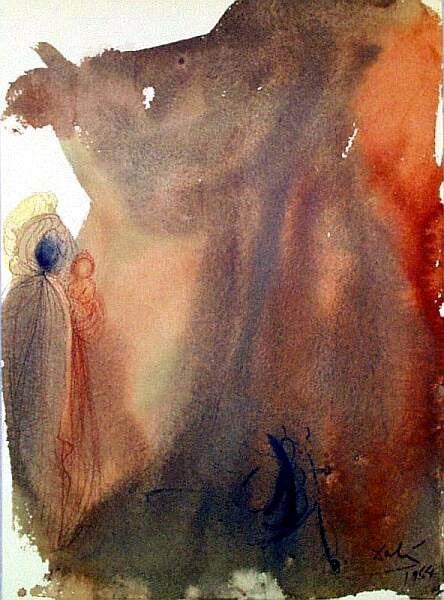
Ecce virgo concipiet (Isaiah 7:14)
Details
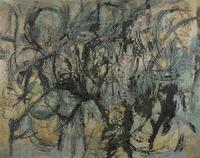
Expert analysis of Salvador Dali’s Ecce virgo concipiet (Isaiah 7:14)
Style: Abstract Expressionism, Symbolism · Genre: religious painting
"Ecce virgo concipiet (Isaiah 7:14)" – Salvador Dalí (Classic Period, 1941–1989)
Style & Significance:
Though Dalí is most widely celebrated as a Surrealist, this work belongs to his Classic Period and marks a decisive turn toward Abstract Expressionism fused with Symbolism. It is a religious painting that reimagines a biblical prophecy through a radical, non-representational vocabulary. The significance lies in Dalí’s late-career synthesis: he abandons the meticulous illusionism of his early Surrealist years in favor of gestural abstraction and potent symbolic density, yet retains a spiritual core. Here, the Annunciation text “Ecce virgo concipiet” (“Behold, a virgin shall conceive”) is not illustrated but evoked through explosive, free-form marks and symbolic geometry, aligning with Abstract Expressionism’s emphasis on the artist’s inner emotional and spiritual state.
Analysis of Composition & Symbolism:
The painting likely employs bold, sweeping strokes and a restrained palette—characteristic of Abstract Expressionism—to suggest the moment of divine conception. Abstract shapes may allude to the dove of the Holy Spirit, a swirling vortex of creation, or a cruciform structure. The Symbolist layer operates through these implied forms: the absence of a literal virgin or angel forces the viewer to meditate on the metaphysical event itself. Dalí’s Classic Period often revisited Christian iconography with a mystical, almost scientific precision; here, that precision is channeled into a raw, painterly energy. The work’s significance thus lies in its bridging of mid-century abstraction with millennia-old sacred text, proving that Dalí’s religious conviction could be expressed through the most modern of means. It stands as a testament to his unceasing experimentation and his unique ability to render the invisible—faith, prophecy, incarnation—in abstract yet deeply symbolic form.
Visually similar
20 works with related composition and palette
Noli me tangere (John 20:1)
Salvador Dali
Untitled
Hryhorii Havrylenko
Untitled
Hans Hartung
The Fairy of the Colours
George Stefanescu
Nude
Hryhorii Havrylenko
Untitled
Wols
Kondor Béla, Jónás
Kondor Béla
A mountain
Wassily Kandinsky
Sponsabo te mihi in sempiternum (Song of Songs 2:12)
Salvador Dali
Spiritus promptus est, caro vero infirma
Salvador Dali
Kleurstudie
Jacoba van Heemskerck
Untitled
Antonio Palolo
The Exaltation
Jules Olitski
Iesus a Satana tentatur (Mark 1:13)
Salvador Dali
Snow Pines
Helen Frankenthaler
Fairies´ Song
George Stefanescu
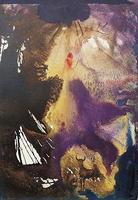
Ego sum Dominus Deus tuus... (Exodus 34:28)
Salvador Dali
G-1
Emil Schumacher
Green Forms
Louis Schanker
GE-11
Emil Schumacher