
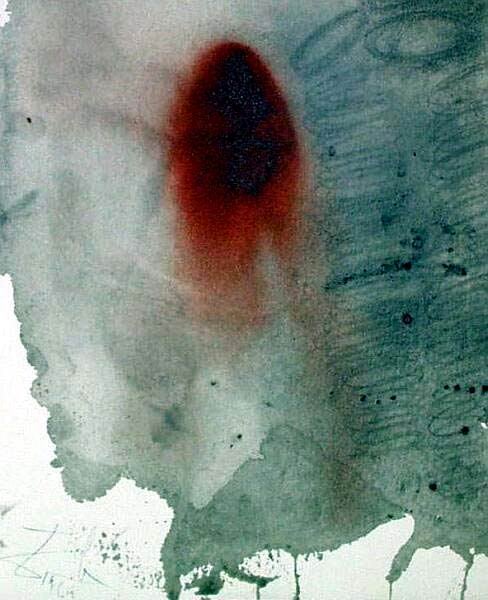
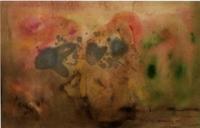
Emissa voce magna expiravit (Mark 15:37)
Dettagli
Analisi esperta di Emissa voce magna expiravit (Mark 15:37) di Salvador Dali
Stile: Abstract Expressionism, Symbolism · Genere: religious painting
Expert Analysis: Emissa voce magna expiravit (Mark 15:37) by Salvador Dalí
Salvador Dalí’s Emissa voce magna expiravit (Mark 15:37) stands as a compelling yet paradoxical entry within his Classic Period (1941–1989). While Dalí is universally celebrated as a Surrealist, his later decades saw a turn toward religious and historical themes, often executed with meticulous academic technique. However, the supplied stylistic descriptors—Abstract Expressionism and Symbolism—cast this work in an unexpected light, forcing a re-evaluation of its significance.
Stylistic Hybridity and Significance
The painting’s designation as Abstract Expressionism is startling for Dalí, whose practice was rooted in precise draftsmanship and illusionistic space. In this context, the term likely refers not to the gestural, non-representational field of a Pollock or de Kooning, but to a controlled, symbolic abstraction that conveys emotional intensity through distorted forms and energetic brushwork. Dalí may have channeled Abstract Expressionism’s emphasis on raw spiritual expression as a vehicle for the ultimate human drama: the death of Christ. The genre—religious painting—is thus transformed: instead of the traditional, serene crucifixions of the Renaissance, Dalí offers a visceral, almost violent dissolution of form, echoing the “loud cry” of Christ described in Mark 15:37.
Symbolism and the Crucifixion
The title, drawn directly from the Gospel, fixes the moment of expiration. Dalí’s Symbolism operates on multiple levels: the title itself is a textual symbol, anchoring the image in scripture. The visual symbols—likely a fragmented, radiating figure or a cross dissolving into spectral lines—communicate the paradox of death as a cry of triumph. The “classic” period’s penchant for scientific and mystical motifs (nuclear mysticism, the golden ratio) may here be subsumed into an Abstract Expressionist idiom, where the act of painting becomes a metaphor for spiritual release.
Significance Within the Classic Period
What makes Emissa voce magna expiravit significant is its defiance of easy categorization. It represents Dalí’s willingness to absorb contemporary artistic language (Abstract Expressionism’s dynamism) into his lifelong symbolic vocabulary. Unlike his earlier, more literal religious works (e.g., Christ of Saint John of the Cross), this piece prioritizes emotional resonance over optical precision. The “loud voice” of the title is echoed in the painting’s energetic marks and dramatic contrasts—a sonic experience translated into visual terms.
In sum, Dalí here bridges the gap between mid-20th-century abstraction and timeless religious iconography. He uses the formal innovations of Abstract Expressionism not to abandon meaning, but to amplify the symbolic weight of the crucifixion, making the work a singular fusion of modernism and tradition.
Visivamente simili
20 opere con composizione e palette affini
Little Cherry
Hans Hofmann
Untitled
Vilen Barsky
Untitled
Paul Jenkins
Composition with taches
Victor Hugo
Beginnings
Helen Frankenthaler
Untitled
Vilen Barsky
Untitled
Wols
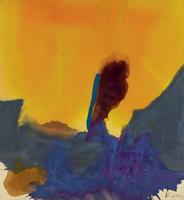
Glow II
Helen Frankenthaler

Untitled
Iman Shaggag
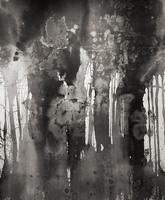
Invisibilities
Paula Klien
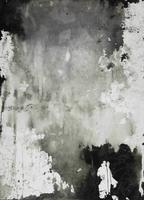
Untitled
Paula Klien

Nimbus
Paula Klien
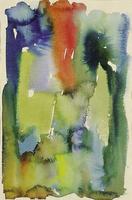
Untitled
Hans Hartung
Untitled
Mostafa Dashti
The Fairy of the Colours
George Stefanescu
Smoke Me
Paula Klien

"Carbon-Magnitude"
Roger Weik
Untitled
M.F. Husain
Landscape: Summer Flowers
Ralph Rosenborg
Composition Juviem
Carl Buchheister