
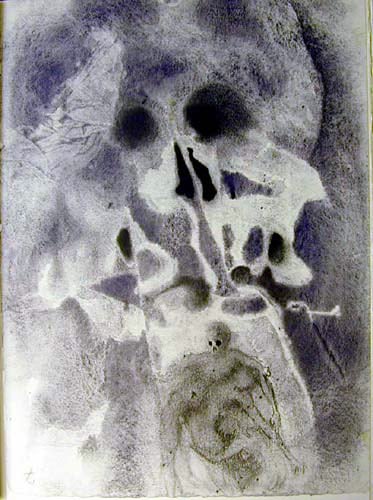
Iosias sepultus in mausoleum patrum (2 Chronicles 35:24)
Details
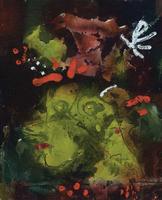
Expertenanalyse zu Salvador Dalis Iosias sepultus in mausoleum patrum (2 Chronicles 35:24)
Stil: Abstract Expressionism, Symbolism · Genre: religious painting
Expert Analysis of Salvador Dalí’s "Iosias sepultus in mausoleum patrum (2 Chronicles 35:24)"
This work belongs to Dalí’s Classic Period (1941–1989), a phase marked by his turn toward religious and historical themes, often infused with his signature symbolic language. Despite the supplied classification of Abstract Expressionism, Dalí’s approach here is more aligned with Symbolism—a key descriptor—since the piece does not rely on the spontaneous, gestural abstraction typical of Abstract Expressionism. Instead, it channels the movement’s energy into a structured, iconographic meditation on mortality and divine providence.
Subject and Symbolism
The title cites 2 Chronicles 35:24, describing the death and burial of King Josiah of Judah. Josiah was a reformer who died in battle, and his burial in the “mausoleum of his fathers” carries deep theological weight—symbolizing the end of a righteous lineage and the fragility of human legacy. Dalí, a master of symbolic layering, likely renders the scene not as a literal narrative but as a metaphysical tableau. The “mausoleum” becomes a threshold between earthly glory and eternal rest, while Josiah’s corpse suggests the transient nature of power.
Stylistic Significance
The dual categorization of Abstract Expressionism and Symbolism is crucial to the work’s significance. Dalí infuses the painting with the expressive, non-representational energy of Abstract Expressionism—perhaps through sweeping, organic forms, a dark, moody palette, or distorted spatial relationships—while anchoring it in highly symbolic content. This fusion was unusual for the period: most Abstract Expressionists rejected narrative and religious symbolism, yet Dalí boldly retained a scriptural anchor. The result is a bridge between the raw emotion of post-war abstraction and the enduring power of biblical allegory.
Place in Dalí’s Classic Period
After his “Classic Period” began in the early 1940s, Dalí moved away from pure Surrealism toward a more disciplined, often religious pictorial language. Works like this one show his fascination with atomic mysticism and Catholic iconography, but here the abstraction suggests a more introspective, even painful meditation on death. The painting’s significance lies in its paradoxical synthesis: it is both a cerebral analysis of a biblical event and an emotive, nearly abstract lament. Dalí proves that religious painting can absorb the formal breakthroughs of modernism without losing its devotional core.
Conclusion
This artwork is significant because it redefines religious painting for a modern audience, employing the visual vocabulary of Abstract Expressionism—usually reserved for pure subjectivity—to explore objective, sacred history. Dalí’s “Josiah” becomes not just a king but a symbol of every mortal confronting the eternal. In doing so, the work stands as a bold testament to Dalí’s ability to merge the chaotic energy of his age with the timeless gravity of scripture.
Visuell ähnlich
20 Werke mit ähnlicher Komposition und Farbpalette
Untitled
Wols
Untitled
Afro
Phenomena High Octane
Paul Jenkins
Red Flight
Friedel Dzubas
Tablecloth VI
Pavlo Makov
Untitled
Paul Jenkins
The Guardian
Lee Krasner
Kay's Travel
Friedel Dzubas
Kleurstudie
Jacoba van Heemskerck
Green Forms
Louis Schanker
Frottis Bleu
Camille Bryen
Untitled
Vasile Kazar
Spiritus promptus est, caro vero infirma
Salvador Dali
Untitled
Jiro Yoshihara
Planeta π
Justin Earl Grant
Vagues
Mario Prassinos
Charred Beloved II
Arshile Gorky
Swan Lake #2
Helen Frankenthaler
Untitled
Hassel Smith
Women in their Sunday best
Paul Klee