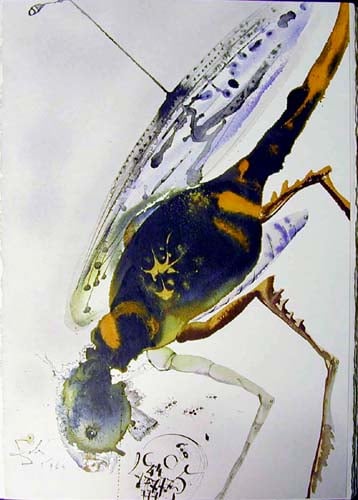
Salvador Dali の Locusta et bruchus の専門的な分析
スタイル:Expressionism, Symbolism · ジャンル:religious painting
Expert Analysis of Salvador Dalí’s Locusta et bruchus (1941–1989, Classic Period)
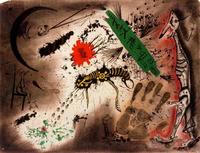
Dalí’s Locusta et bruchus is a striking religious painting that bridges his late Surrealist sensibilities with the symbolic intensity of Expressionism and Symbolism, marking a pivotal moment in his so-called Classic Period (1941–1989). The title, Latin for “Locust and Beetle,” directly evokes the biblical plague of locusts (Exodus 10), yet Dalí transforms this Old Testament motif into a deeply personal meditation on destruction, metamorphosis, and spiritual crisis.
Within the framework of Expressionism, Dalí abandons his earlier hyperrealist precision in favor of distorted, almost violent forms—the locust and beetle are rendered with exaggerated, angular bodies that seem to writhe and swell, their carapaces cracked like scorched earth. This expressive exaggeration heightens the sense of menace and decay, while the Symbolist dimension layers the insects with metaphysical meaning: locusts traditionally signify divine punishment or apocalyptic upheaval, while beetles (like the scarab) carry connotations of rebirth and cyclical time in esoteric symbolism. Dalí here conflates judgment and transformation, suggesting that the sacred is inseparable from the grotesque.
Stylistically, the work belongs to Dalí’s post-war “nuclear mysticism” phase, where he fused Catholic iconography with scientific and mythological references. The palette—muted earth tones punctuated by searing yellows and blood-red accents—evokes both parched landscapes and the fire of divine wrath. The insects are arranged in a cruciform composition, hinting at the cross, while their shadowed forms seem to flicker between organic life and mechanical rigidity, a hallmark of Dalí’s exploration of “paranoiac-critical” symbolism.
What makes Locusta et bruchus significant is its radical reinterpretation of religious painting through a dual lens of Expressionist emotionalism and Symbolist allegory. Dalí rejects traditional depictions of piety or martyrdom, instead centering the work on creatures of biblical plague as vehicles for transcendence. The painting thus stands as a key artifact of Dalí’s Classical Period, where he abandoned Surrealism’s dreamy irrationality to confront the sacred with a raw, almost medieval intensity—yet filtered through modern anxieties about war, atomic power, and existential decay. It is a testament to Dalí’s belief that the divine could be found in the monstrous, and that the most profound religious art arises not from serene devotion but from the wound of destruction.
視覚的に類似
構図やパレットが近い作品 20 件
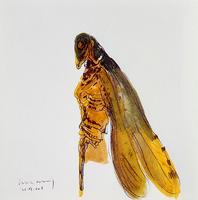
Untitled
Graca Morais
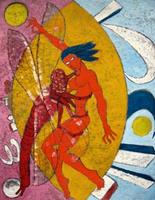
In embrace of a dragonfly
Endre Bartos
Babits: The book of Jonah III.
Maria Bozoky
Theater Sketch
Valeria Trubina
Chapulín (Grillo Con Peces)
Francisco Toledo
Flea hunting in ancient forest
Theodor Severin Kittelsen
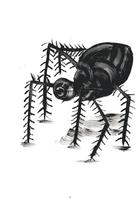
Drow-ink 20
Ikhwan Sugianto
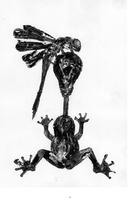
Drow-ink 33
Ikhwan Sugianto
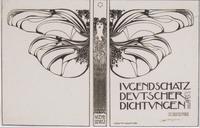
Cover Design for Ewart Felicie Jugendschatz German seals
Koloman Moser
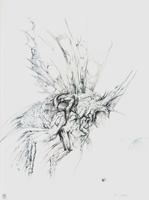
Perpetuum Mobile
Wojciech Siudmak
Window Towards Insomnia (3)
Vasile Kazar
Dragonfly pin
Louis Comfort Tiffany
Krigen Mellom Froskene Og Musene 09
Theodor Severin Kittelsen
Painting-Object (Wing)
Florin Maxa
Insects and Reptiles
Jan van Kessel the Elder
The Chase
Richard Hunt
Man in a Storm
Alfred Kubin
Drow-ink 14
Ikhwan Sugianto
Suite Al-Lucinacions III
Joan Ponc
Crawling
Dana Schutz