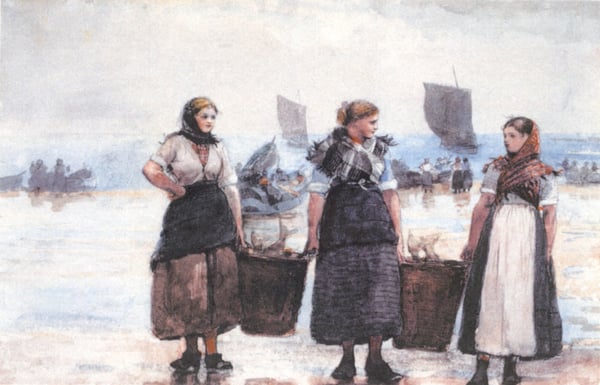
Analisi esperta di Fisherwomen, Cullercoats di Winslow Homer
Stile: Realism · Genere: genre painting
Expert Analysis: "Fisherwomen, Cullercoats" by Winslow Homer
This work belongs to Winslow Homer’s highly productive Cullercoats period (1881–1882), during which he lived in the fishing village of Cullercoats on the northeast coast of England. The painting depicts a group of women—likely the wives, widows, and daughters of fishermen—engaged in the arduous daily labor of gathering bait or sorting the catch on a windswept shore. Homer renders the scene in a muted palette of grays, browns, and blues, with the North Sea’s restless waves and overcast sky forming a stark backdrop.
Significance within Realism and Homer’s Oeuvre
-
Shift Toward Monumental Genre Painting – Prior to his English sojourn, Homer was known for more anecdotal, often nostalgic scenes of American rural life. In Fisherwomen, Cullercoats, he moves decisively toward the gritty, unsentimental observation that defines European Realism—especially the influence of French painters like Gustave Courbet and the Barbizon school. The women are not idealized; they are shown as sturdy, weather-beaten figures whose postures convey the physical weight of their work. This marks a turning point in Homer’s career, where the everyday becomes heroic.
-
Emphasis on Human Dignity in Labor – Realism as a movement sought to ennoble ordinary people by presenting them with the same seriousness previously reserved for history or religious painting. Homer achieves this by placing the fisherwomen against a vast, elemental landscape—the sea and sky—that dwarfs them but does not diminish their resolve. Their heavy skirts, bent backs, and simple clothing are rendered with meticulous attention to texture and function, reinforcing the idea that their struggle is both real and noble.
-
Mastery of Atmospheric Realism – Homer’s handling of light and weather in this painting is precise and evocative. The damp, salt-laden air, the chill of the wind, and the constant threat of the sea are palpable. This reflects the Realist commitment to capturing the truth of a specific environment—here, the harsh coastal climate that defines the fisherwomen’s existence. The subdued color harmony and loose, vigorous brushwork anticipate Homer’s later, more powerful marine scenes.
-
Influence on American Painting – While Homer had already achieved recognition in the United States, the Cullercoats works, including Fisherwomen, Cullercoats, introduced a new gravity to American genre painting. They helped steer American art away from the genteel, narrative focus of the Hudson River School and toward a more direct, unidealized engagement with life’s realities—paving the way for later American realists and regionalists.
In sum, Fisherwomen, Cullercoats is significant as a watershed moment in Winslow Homer’s evolution from an illustrator of American scenes to a painter of universal human endurance. It exemplifies how the Realist movement could transform a modest genre subject into a powerful statement about labor, nature, and the unheroic heroes of daily survival.
Visivamente simili
20 opere con composizione e palette affini
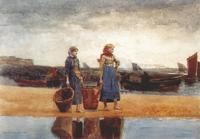
Two Girls on the Beach, Tynemouth
Winslow Homer
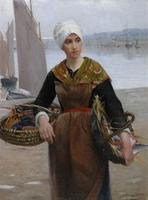
Young Breton Woman
Alfred Guillou
Gathering Cockles at the Seashore
Eugene de Blaas
Women on the Beach at Berck
Eugene Boudin
Study of a peasant woman
Hugo Mühlig
The Fish Fag
William Banks Fortescue

Sweet shell-fishers
Pierre-Marie Beyle
Fisherwomen
Joaquín Sorolla
The Luciana
Vincenzo Migliaro
Inside the bar
Winslow Homer
Tuscan female peasants
Cristiano Banti
Fishing for Oysters at Cancale
John Singer Sargent
The Mussel Gatherers
Eugene de Blaas
Souvenir de dour Amenez
Jules Breton
Laundresses on Lake Garda
Ettore Tito
Valencian Fishwives
Joaquín Sorolla

At the Seashore
Anna Bilińska
Women and Fishermen of Hornbaek
Peder Severin Kroyer
Fleur des Greves
Pierre-Marie Beyle
Cloudy seascape of people gathering along the shore with baskets of fish in their hands and on the ground
Melbourne Havelock Hardwick