Analisi esperta di Palm tree, Nassau di Winslow Homer
Stile: Realism · Genere: landscape
Expert Art Historical Analysis: "Palm Tree, Nassau" by Winslow Homer
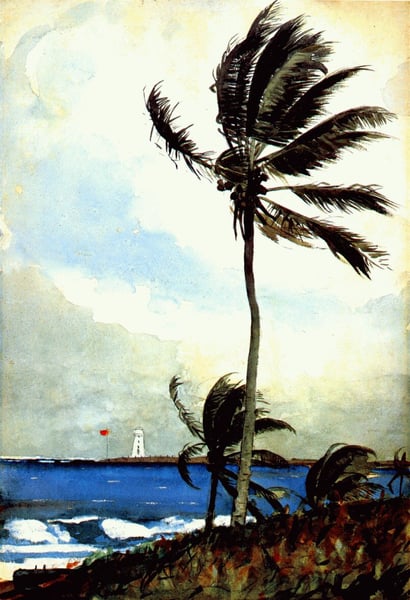
Winslow Homer’s Palm Tree, Nassau is a compelling example of American Realism applied to a tropical landscape, distinct from his more familiar marine scenes of New England. Executed during one of Homer’s several sojourns to the Bahamas in the 1880s–1890s, this work captures the essence of the Caribbean environment with an unflinching, almost documentary fidelity that defines the Realist ethos.
Significance within Realism and Genre
The painting’s significance lies first in its refusal to romanticize the exotic. Where many contemporary artists might have idealized the tropical scene with lush, sentimental brushwork, Homer instead treats the palm tree—the sole protagonist—with the same rugged objectivity he would bring to a Maine schooner or a Adirondack guide. The trunk is rendered with precise, textured strokes that emphasize its weathered, scaly bark, while the fronds are shown in sharp silhouette against a brilliant sky. This is not a generic “palm tree” but a specific, observed specimen, grounded in a particular time and place (Nassau).
As a landscape, the composition is deceptively simple yet powerfully balanced: the palm dominates the frame, its curvature echoing the arc of the horizon or the implied motion of the trade winds. Homer uses the tree as both object and structure, creating a dynamic tension between the vertical thrust of the trunk and the horizontal expanse of sea and sky. The result is a meditation on form and light, stripped of narrative excess—a hallmark of Homer’s mature Realist style.
Technical and Conceptual Innovation
Homer’s handling of light is particularly noteworthy. The intense, bleaching sun of the Bahamas is captured through a restricted palette of warm whites, sandy yellows, and deep greens, with the palm’s shadow cutting across the foreground as a stark, abstract shape. This attention to atmospheric effect—the glare, the humidity, the stillness of the air—elevates the work beyond mere topographical record. It demonstrates how Realism can convey the sensation of a place as much as its outward appearance.
Furthermore, Palm Tree, Nassau reflects Homer’s broader interest in the intersection of nature and human presence. While no figures appear, the tree itself is a marker of cultivation and habitation, common in the gardens and streets of Nassau. It subtly alludes to the colonial context of the Caribbean, yet Homer focuses on the resilience and beauty of the natural world—a theme that would resonate through his later, more austere seascapes.
In summary, this painting is significant because it shows Homer extending Realism’s principles—faithfulness to visual truth, emphasis on light and structure, and rejection of sentiment—into a genre often prone to picturesque cliché. Palm Tree, Nassau stands as a bridge between Homer’s earlier Civil War and rural scenes and his later, elemental depictions of the ocean, demonstrating his consistent ability to find universal significance in a single, well-observed tree.
Visivamente simili
20 opere con composizione e palette affini
Storm, Bahamas
Winslow Homer
Coconut Palms, Key West
Winslow Homer
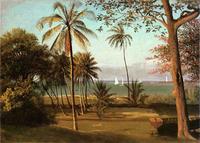
Florida Scene
Albert Bierstadt
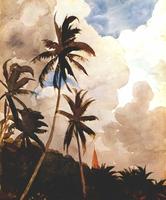
Palm trees (Bahamas)
Winslow Homer
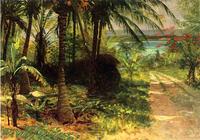
Tropical Landscape
Albert Bierstadt
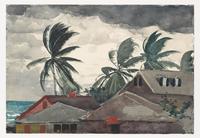
Hurricane, Bahamas
Winslow Homer
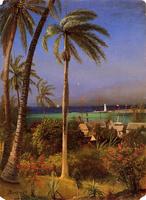
Bahamian View
Albert Bierstadt
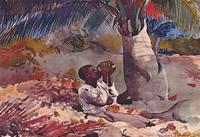
Under the coco palm
Winslow Homer
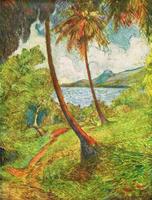
Landscape of Martinique
Charles Laval
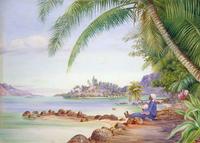
View of Round Island and a Part of St Anne's from Quarantine Island
Marianne North
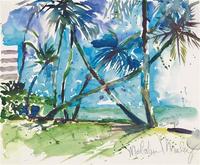
Key Biscayne Florida
Malcolm Morley
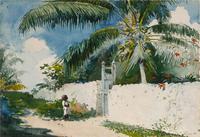
A Garden in Nassau
Winslow Homer
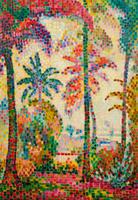
Paysage Tropical
Jean Metzinger
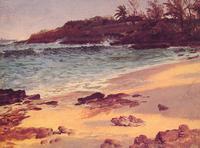
Bahama Cove
Albert Bierstadt
Tobacco Caye. Brit. Honduras
Henry Scott Tuke
Island (diptych)
Oleg Holosiy
Palm Grove
Valeria Trubina
Goan Beach
John Miller
Street Scene, Bombay
Edwin Lord Weeks
Main Street in N'dar-tout
Edouard Riou