Expertenanalyse zu Winslow Homers Rainy Day in Camp (also known as Camp near Yorktown)
Stil: Realism · Genre: genre painting
Expert Analysis: "Rainy Day in Camp (also known as Camp near Yorktown)" by Winslow Homer
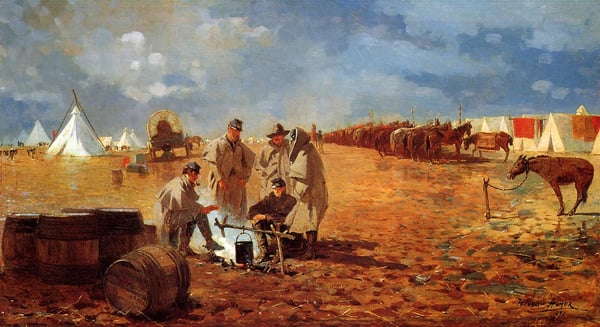
Winslow Homer’s Rainy Day in Camp (c. 1863–1865) stands as a pivotal work within the Realist movement and a defining example of American genre painting during the Civil War era. The painting depicts a group of Union soldiers huddled under a makeshift shelter, enduring the dreary, muddy conditions of camp life near Yorktown, Virginia.
Significance within Realism and Genre Painting:
Homer, who served as an artist-correspondent for Harper’s Weekly, deliberately rejected the heroic, romanticized battle scenes typical of earlier war art. Instead, he focused on the mundane, often uncomfortable realities of soldiering—idleness, boredom, and the harshness of weather. This aligns with the Realist commitment to depicting everyday life without idealization. The muted earth tones, blurred outlines, and emphasis on atmosphere (the rain, the damp air) demonstrate Homer’s consummate skill in conveying mood through subtleties of light and texture.
What Makes It Important:
- Humanizing the Soldier: By showing exhausted, unheroic figures enduring rain, Homer reframes the Civil War not as a grand conflict but as an experience of shared human endurance. The soldiers’ slumped postures and the cramped, sodden shelter evoke empathy rather than glory.
- Innovation in Landscape and Figure Integration: Homer treats the soldiers as part of the landscape—their brown uniforms blend with the mud, and the tent becomes an organic extension of the terrain. This unity foreshadows his later mastery of maritime scenes.
- Documentary Eye: As a firsthand witness, Homer recorded the physical and psychological toll of camp life, offering a powerful counter-narrative to contemporary propaganda. The painting’s original title, Camp near Yorktown, anchors it in a specific historical moment—the 1862 Peninsula Campaign—yet its quiet, timeless composition elevates it to a universal meditation on waiting and resilience.
Within the canon of American Realism, Rainy Day in Camp is a masterclass in using genre painting to reveal the unspoken truths of war, cementing Homer’s legacy as an artist who painted not just what soldiers did, but what they felt.
Museum / Gallery
Visuell ähnlich
20 Werke mit ähnlicher Komposition und Farbpalette
Genre Scene
Konstantin Makovsky
Camp Cook's Troubles
Charles M. Russell
Campfire. Kachanovka
Konstantin Makovsky
Bivouac Russian soldiers
August von Pettenkofen
Market fair in Poltava
Vladimir Makovsky
Fair
Vladimir Makovsky
Peasant Dinner during Harvesting
Konstantin Makovsky
Watering
Károly Lotz
Fair in Ukraine
Vladimir Makovsky
Two hawks (Bashi-bazouk)
Vasily Vereshchagin
Bronc for Breakfast
Charles M. Russell
Russian Camp in Turkestan
Vasily Vereshchagin
Gypsy camp in the Puszta
Anton Romako
Rainy Morning
Charles M. Russell
Forgiveness in the St. Anne chapel at Palud Plonévez Porzay (Finistère)
Eugene Boudin
Gypsy family
August von Pettenkofen
The transport of the wounded II
August von Pettenkofen
Horse market in Szolnok I
August von Pettenkofen
Sheoak Sam
George Washington Lambert
Rainy Morning
Charles M. Russell