Description
Style: Realism · Genre: genre painting
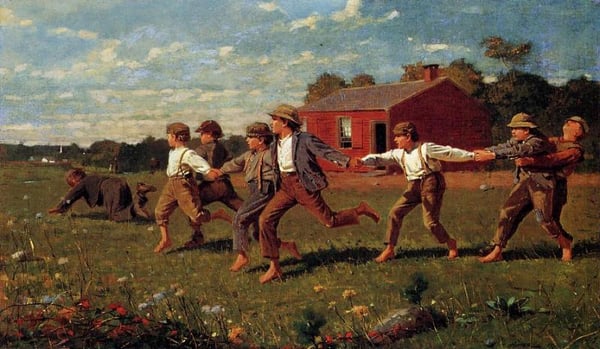
In the years after America's brutal Civil War (1861-65), children—as embodiments of innocence and the promise of America's future—became a popular artistic subject. Snap the Whip, one of Homer's most beloved works, evoked nostalgia for the nation's agrarian past as the population shifted to cities. Released from their lessons, the exuberant bare-footed boys engage in a spirited game of snap the whip, which required teamwork, strength, and calculation—all important skills for a reuniting country. Their clothing, more specifically their caps, suspenders, and short pants, reflects the true late 1800 American attire.
Featured in the background is the familiar little red schoolhouse; the school teachers in the distance are most likely meant to be supervising the usual recess activity. The scenic landscape of trees and wildflowers bordering a small field is so realistic that the viewer can almost hear the chirping of the birds and the buzzing of the insects. The boys' bare feet signal childhood's freedom, but their suspenders are associated with manhood's responsibilities. Observed from right to left, Homer's boys hang on to one another, strain to stay connected, run in perfect harmony, and fall away, enacting all the possible scenarios for men after the Civil War.
Art historian Edward Lucie-Smith described in his text, American Realism, "Childhood and the life of children took on a special significance in America in the years following the Civil War, and these images symbolized the will to rebuild and to make a stronger and more vigorous nation." Subtle allusions to the lost generation of Civil War soldiers, the young widows left behind along with the hopes for the next generation provide the underlying narrative of these post-war works which focus on the lives of young teachers and their students.
An earlier, larger version of this subject (Butler Institute of American Art) was among the most celebrated paintings at the 1876 Centennial International Exhibition, held in Philadelphia—America's first world's fair. The Met's version differs from the original in its background, with a wide blue sky replacing a lush mountain range, making the image less regionally specific.
Museum / Gallery
Visually similar
20 works with related composition and palette
Snap the Whip
Winslow Homer
Ring-a-Ring-a-Roses-Oh
Frederick Morgan
Midsummer Night Dance in Courrières
Jules Breton
In the spring meadow
Ludwig Knaus
The Tournament
Ralph Hedley
Жертва фанатизму
Микола Пимоненко
The Feast of Saint John
Jules Breton
Off to the Fair
Frederick Morgan
The halted Pilgrimage (The assistance)
Ferdinand Georg Waldmüller
The harvest in the Roman Countryside
Ramón Tusquets y Maignon
The Wayfarers
David Cox
Grindslanten
August Malmstrom
Winter
Augustus Edwin Mulready
Ring a Ring O' Roses
Ettore Tito
Traditional Swedish dance
August Malmstrom
Figures on the Seashore
William Collins
Return from the Church Fair
Ferdinand Georg Waldmüller
Journey of the quarterly family on a pilgrimage. Sketch
Vasily Perov
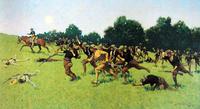
Charge of the Rough Riders at San Juan Hill
Frederic Remington
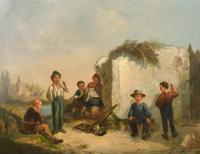
a group of children playing with village buildings beyond
Jean-Charles Langlois