Expert analysis of Winslow Homer’s The Adirondack Guide
Style: Realism · Genre: genre painting
Expert Analysis of "The Adirondack Guide" by Winslow Homer
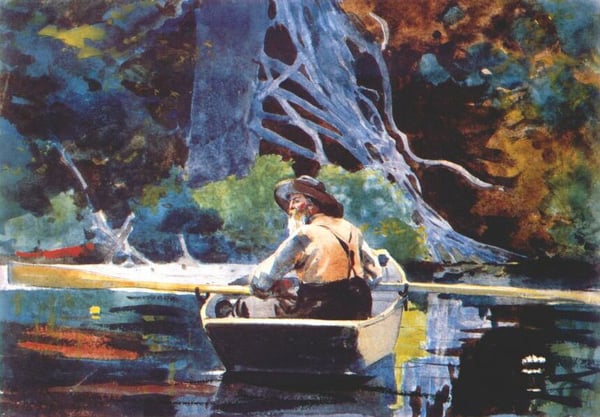
As a masterwork of Realism executed within the genre painting tradition, The Adirondack Guide stands as a significant testament to Winslow Homer’s fidelity to authentic, unidealized depictions of everyday life. The painting’s importance lies in how it synthesizes two core tenets of Realism: the honest portrayal of the natural world and the elevation of ordinary people to subjects worthy of serious artistic attention.
Significance within Realism
Homer rejects the romantic or pastoral conventions common in 19th-century landscape painting. Instead, he presents a lone guide in a canoe—a figure whose anonymity and quiet dignity embody the Realist commitment to truth. The guide is not a heroic explorer or a mythological figure; he is a working man, intimately connected to the Adirondack wilderness. Homer’s precise handling of light on water, the texture of the canoe, and the muted, naturalistic palette underscores the Realist obsession with direct observation. The composition—centered but unposed—captures a fleeting, authentic moment, prioritizing empirical fact over dramatic narrative.
Significance within Genre Painting
As a genre painting, this work defies typical anecdotal or sentimental genre scenes of the era. Homer uses the genre to focus on a specific, regional identity—the Adirondack guide—while avoiding moralizing or theatricality. The guide’s face is partially hidden, forcing the viewer to read his role through posture, equipment (pole, boat, simple clothing), and environment rather than emotional expression. This restraint amplifies the painting’s quiet power; the guide becomes a symbol of self-reliance and harmony with nature, yet remains an individual rooted in his labor. In doing so, Homer elevates genre painting from mere documentation to a profound meditation on human purpose and place.
Conclusion
The Adirondack Guide is significant because it exemplifies how Realist genre painting could achieve both documentary accuracy and poetic resonance. Homer’s refusal to embellish—coupled with his masterful observation of a solitary guide at work—makes the painting a landmark in American art. It stands as a definitive statement of the Realist ethos: finding the extraordinary within the ordinary, and the universal within the specific.
Museum / Gallery
Visually similar
20 works with related composition and palette
Mrs. Chase in Prospect Park
William Merritt Chase
In a Boat
Victor Borisov-Musatov
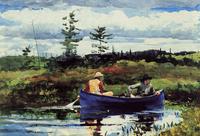
The Blue Boat
Winslow Homer
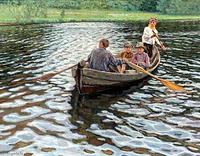
On the Lake
Nikolay Bogdanov-Belsky
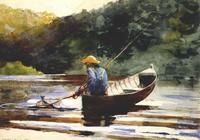
Boy Fishing
Winslow Homer
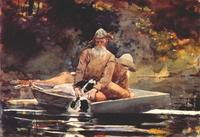
After the hunt
Winslow Homer
On the boat. Abramtsevo.
Vasily Polenov
Summer Evening
Albert Edelfelt
Boating
Egon Schiele
In the Boat
Nikolaos Lytras

Rowboat
David Park
Flickorna I Båten
Albert Edelfelt
Boaters on the Yerres
Gustave Caillebotte

Woman in a Boat
Pierre-Auguste Renoir
A Good One, Adirondacks
Winslow Homer
Two fishermen
Emmanuel Zairis
Boatman on the Hawkesbury River, at Cole and Candle Creek, near Akuna Bay
Julian Ashton
Banks of the Yerres
Gustave Caillebotte
Man Rowing a Dinghy
Henry Scott Tuke
Keeping Her off
Henry Scott Tuke