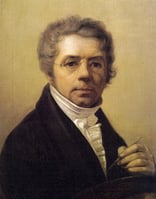
Экспертный разбор работы «Reaper» художника Alexey Venetsianov
Стиль: Realism · Жанр: portrait
Expert Art Historical Analysis: Reaper by Alexey Venetsianov
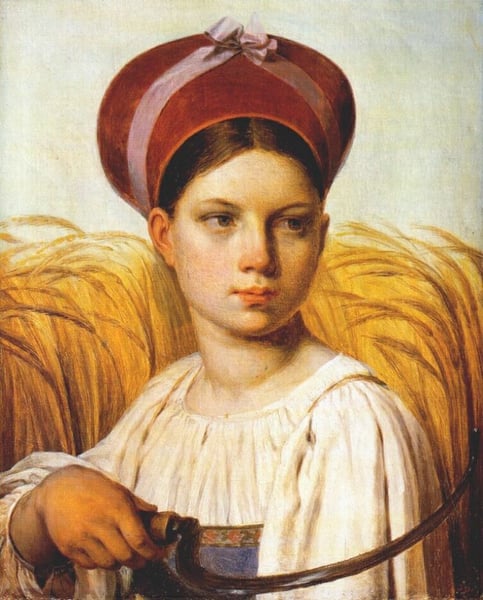
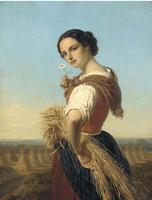
Alexey Venetsianov’s Reaper stands as a seminal work within the Russian Realist tradition, marking a decisive shift away from the idealized, mythological subjects favored by the Imperial Academy. Painted in the early 19th century, the portrait depicts a young peasant woman at rest in a golden field, her scythe momentarily set aside. What makes this work significant is its radical, almost revolutionary, commitment to depicting ordinary rural life with dignity and natural grace—a choice that would help lay the groundwork for the later Peredvizhniki (The Wanderers) movement.
Stylistic and Contextual Significance:
- Pioneering Russian Realism: Venetsianov was among the first Russian artists to treat peasant life not as a picturesque background for aristocratic leisure, but as a subject worthy of serious portraiture. Reaper epitomizes this: the woman is neither caricatured nor sentimentalized. Her direct gaze, sun-warmed skin, and simple clothing are rendered with a quiet realism that elevates her to the status of a classical figure.
- Mastery of Light and Atmosphere: The painting’s luminosity is a hallmark of Venetsianov’s technique. The summer sun filters through the stalks, casting warm highlights on the woman’s face and hands, while the deep shadows of the grain field suggest the weight of her labor. This naturalistic use of light—informed by his close observation of the Russian countryside—was unprecedented in Russian academic painting and aligned with emerging European Realist trends.
- Dignity in Labor: Unlike earlier scenes of peasants that often emphasized hardship, Venetsianov presents a moment of quiet repose. The reaper’s strong, capable hands, the curved blade of the scythe, and the rhythmic organization of composition all convey a sense of purpose and harmony between human and nature. This egalitarian vision was a direct challenge to the aristocratic aesthetic of the time.
- Influence on National Identity: Reaper and similar works by Venetsianov (such as The Threshing Barn and Spring. Ploughing) helped forge a distinctly Russian visual identity—one rooted in the land, its people, and the cycles of agricultural life. The painting is thus not only a portrait of an individual but a quiet manifesto for a national art based on lived experience.
Conclusion:
In Reaper, Venetsianov achieves what few before him had attempted in Russia: the union of academic precision with genuine empathy for the subject. This portrait stands as a foundational stone of Russian Realism, anticipating the social conscience of Repin and the luminous landscapes of Levitan. Its significance lies in its quiet power—a reminder that the greatest art often finds its monument not in heroes or gods, but in the ordinary grace of a woman pausing in the field.
Визуально похожие
20 работ с близкой композицией и палитрой
Peasant Girl with a Sickle in the Rye
Alexey Venetsianov
A Peasant Woman with Scythe and Rake
Alexey Venetsianov
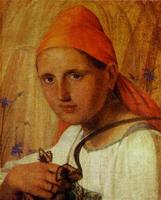
Peasant Girl with Butterflies
Alexey Venetsianov
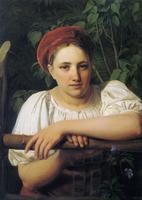
A Peasant girl from Tver
Alexey Venetsianov

A Peasant Girl with Embroidery
Alexey Venetsianov

Girl with Accordion
Alexey Venetsianov
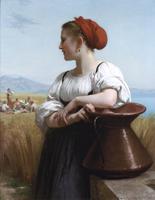
Moissoneuse
William-Adolphe Bouguereau
The Harvester
William-Adolphe Bouguereau
Portrait
Konstantin Makovsky

Woman from Ciociaria with red veil
Elisabeth Jerichau-Baumann
Girl with Jug
Konstantin Makovsky

Reapers
Alexey Venetsianov

Italian Girl
Hugues Merle
Young Shepherdess
William-Adolphe Bouguereau

Peasant Woman with Milk
Alexey Venetsianov
Young Italian with Sour Oranges
Konstantin Makovsky

A friend in need
Émile Auguste Hublin

Le Bouquet de Violettes
William-Adolphe Bouguereau
Springtime
Francois Verheyden

Italian Girl
Fyodor Bronnikov