Expertenanalyse zu John Henry Twachtmans Connecticut Landscape
Stil: Impressionism · Genre: landscape
Expert Analysis: Connecticut Landscape by John Henry Twachtman
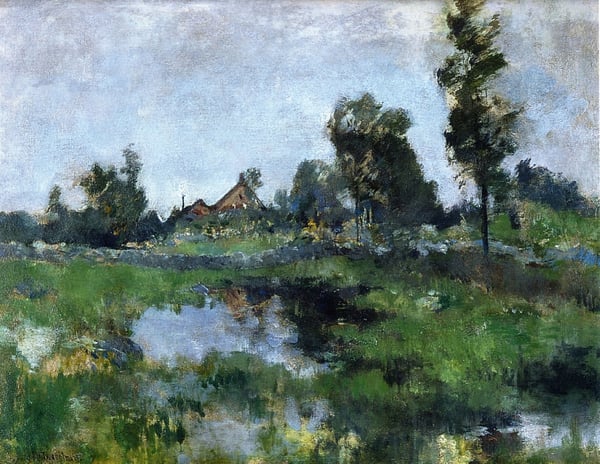
John Henry Twachtman’s Connecticut Landscape stands as a quintessential example of American Impressionism, yet it distinguishes itself through a quieter, more introspective interpretation of the style. While French Impressionism often revels in vibrant, sun-drenched scenes and broken color, Twachtman’s approach is characterized by subtle tonal harmonies, a restrained palette, and an emphasis on atmosphere over anecdote.
Significance within Impressionism
Twachtman was a member of the “Ten American Painters”—a group that broke from conservative institutions to champion a more personal, painterly approach. In Connecticut Landscape, he applies the Impressionist fascination with light and transient effects, but he filters it through a distinctly American sensibility: a reverence for the unassuming, pastoral landscape.
Key compositional and stylistic features
- Subdued palette: Unlike the high-key colors of Monet or Renoir, Twachtman uses muted greens, soft grays, and pale blues. This gives the scene a hushed, almost poetic quality, echoing the influence of James McNeill Whistler’s tonalism and Japanese aesthetic principles.
- Atmospheric unity: The painting dissolves crisp boundaries between sky, foliage, and ground, creating a veil of atmosphere. The brushwork is loose yet deliberate—dabs and strokes that suggest the shimmer of leaves and the damp air of a Connecticut countryside.
- Intimate scale: Twachtman often favored modest, even cropped compositions that draw the viewer into a personal encounter with nature, rather than a grand spectacle. Here, the landscape feels both immediate and meditative.
Why it matters
Connecticut Landscape exemplifies the American variant of Impressionism that prioritized mood and the quiet poetry of everyday places. Twachtman’s ability to merge European impressionistic techniques with a native sense of stillness and solitude makes this work a significant bridge between the radical innovations of French Impressionism and the emerging, uniquely American vision of the late 19th century. It is a testament to how Impressionism could be adapted to capture not just the effects of light, but the spirit of a place.
Museum / Gallery
Visuell ähnlich
20 Werke mit ähnlicher Komposition und Farbpalette
Scheiber Hugó, Örvénylő Felhők
Scheiber Hugó
Nocturne, Templestowe
David Davies
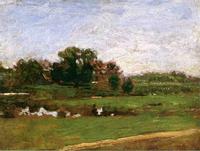
Study for The Meadows
Thomas Eakins
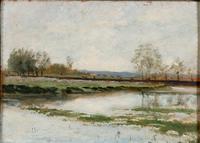
Landscape
Maxime Maufra
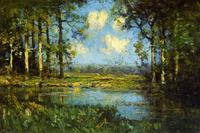
The Woodland Pool
Robert Julian Onderdonk
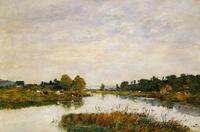
The Still River at Deauville
Eugene Boudin
Late Afternoon
Robert Julian Onderdonk
View Of Méréville
Maximilien Luce
River Meanders
Trush Ivan Ivanovych
The Toques at Saint-Arnoult
Eugene Boudin
Banks of a River
Pierre-Auguste Renoir
Banks of the River
Pierre-Auguste Renoir
Banks of the Loing
Alfred Sisley
Autumn landscape
Theodor Philipsen
The Toques at Saint-Arnoult
Eugene Boudin
Dull day
Isaac Levitan
Autumn
Isaac Levitan
Cattle on the Bank of the River
Charles-Francois Daubigny
Long Island Landscape after a Shower of Rain
William Merritt Chase
Autumn
Sergiy Grigoriev