Expertenanalyse zu John Henry Twachtmans Niagara Gorge
Stil: Impressionism · Genre: landscape
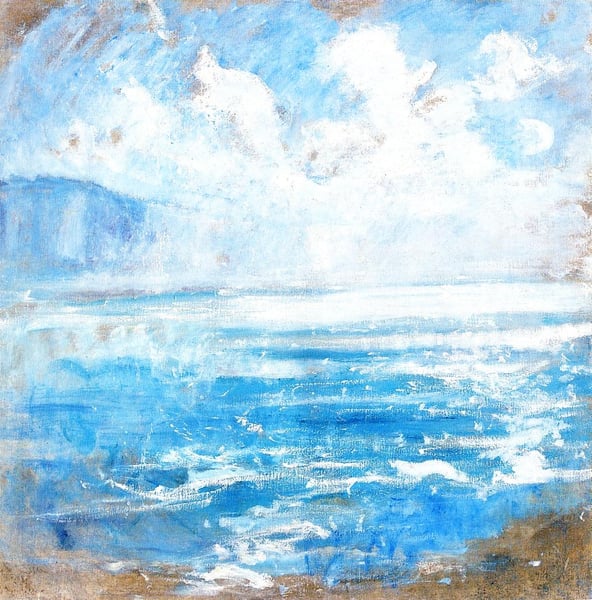
John Henry Twachtman’s Niagara Gorge (c. 1893–95) exemplifies the distinctly American adaptation of Impressionism, where the artist shifts away from the bright, sun-drenched palette of French contemporaries toward a more muted, atmospheric lyricism. Painted during a period when Twachtman was living near the Niagara region, the work captures the chasm’s powerful geology and flowing water not as a dramatic spectacle but as a quiet, almost meditative study in light, vapor, and form.
Significance within Impressionism and Twachtman’s Oeuvre:
-
Tonal Impressionism: Unlike Monet’s vibrant color contrasts, Twachtman employs a narrow, subdued range of grays, soft greens, and pale blues. The mist and spray from the gorge dissolve hard edges, creating a veiled, intimate effect that emphasizes atmosphere over topographical detail. This approach connects him to the “Tonalist” wing of American Impressionism.
-
Compositional restraint: The painting avoids the iconic cataract (Horseshoe Falls) and instead focuses on the gorge’s layered rock walls and flowing river. Twachtman reduces the scene to broad horizontal bands—sky, cliffs, water—linked by the vaporous haze. This simplification evokes a sense of timeless tranquility, contrasting with the sublime, awe-inspiring Niagara painted by earlier artists like Frederic Church.
-
Personal, poetic interpretation: Twachtman often painted familiar sites repeatedly, yet Niagara Gorge stands out for its almost abstract quality—the brushwork is loose and suggestive, the tone moody. It reflects his belief that a landscape should express the artist’s inner feeling rather than merely record a place. Here, the gorge becomes a vehicle for conveying silence, change, and the passage of light.
Artistic context: Twachtman was a member of the “Ten American Painters,” a group that broke from academic conventions. Niagara Gorge represents his mature style, where he synthesizes French Impressionist broken color with a more personal, Japanese-inspired sense of asymmetry and space. The work is significant for showing how American Impressionism could treat a national landmark not as a symbol of power but as a quiet, fleeting vision—making it a bridge between 19th-century landscape traditions and early modernist sensibilities.
Museum / Gallery
Visuell ähnlich
20 Werke mit ähnlicher Komposition und Farbpalette
Egry József , Szölőhegy 1938
Egry József
Sea etude
Mikalojus Konstantinas Ciurlionis
Sunset
J.M.W. Turner
Sunrise at Ramiro Spring
Armando Reveron
Sunset
Panayiotis Tetsis
Sea
Arkhyp Kuindzhi
Marina
Samuel Mutzner
Sunset over the Hills
Glenn Cooper Henshaw
Creation of the World XIII
Mikalojus Konstantinas Ciurlionis
The view from my window
Alfred Freddy Krupa
Paisaje blanco
Armando Reveron
Paesaggio Rosa
Paolo Salvati
Quiet Moonlight (beyond Catalina Island)
Granville Redmond
Light on the lagoon
Angelo Morbelli
Sunlight
Alina Danilova
April Coastal Clouds
Finch Sheila
Biarritz
Kimon Loghi
LANDSCAPE (NORTH COUNTY DUBLIN)
Nathaniel Hone the Younger
Seascape
Gustave Courbet
Mer
Josef Sima