Norman Rockwell sanatçısının Parade eseri hakkında uzman analizi
Tarz: Regionalism · Tür: genre painting
Expert Analysis of Norman Rockwell’s Parade (Regionalism, Genre Painting)
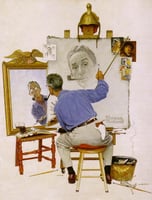
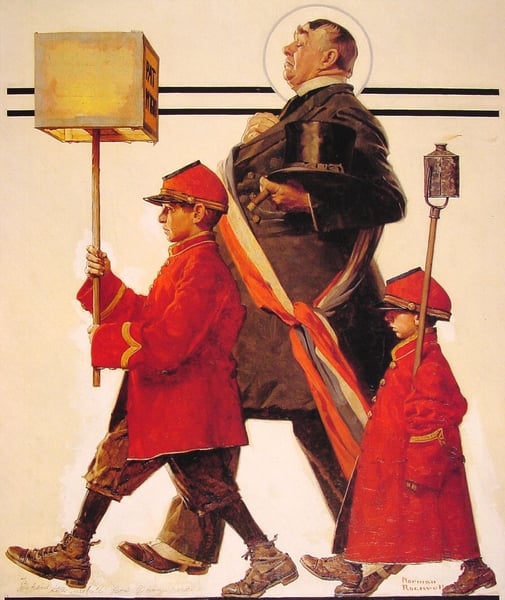
Norman Rockwell’s Parade stands as a quintessential example of Regionalism in American art, a movement that celebrated the everyday life, values, and landscapes of rural and small-town America during the 1930s and 1940s. As a genre painting—an image depicting ordinary people engaged in common activities—this work achieves significance through its masterful storytelling, emotional accessibility, and its role in shaping a nostalgic, unified national identity.
Stylistic Significance within Regionalism
Regionalism emerged as a reaction against European modernism and urbanization, aiming to capture the authentic spirit of American heartland communities. Rockwell, though often classified as an illustrator, fully embraced this ethos in Parade. The painting’s composition centers on a local town parade—a ritualistic, communal event that reinforces bonds of place and tradition. The artist’s meticulous attention to detail (the bunting-draped storefronts, the small-town architecture, the diverse cast of townsfolk) aligns with Regionalist principles of depicting specific, recognizable locales rather than idealized or abstract scenes. Rockwell’s realism, with its warm, earthy palette and careful modeling of light, creates a tactile sense of place that feels both immediate and timeless.
Narrative and Emotional Resonance as Genre Painting
As a genre painting, Parade excels in its ability to tell a layered story through subtle visual cues. The painting likely captures a moment of collective anticipation or celebration: children clutching flags, veterans in uniform, families lined along the street. Rockwell’s genius lies in his empathetic characterizations—each figure is distinct yet relatable, from the eager boy in the foreground to the elderly couple observing from a porch. This democratization of attention (no one figure dominates) reinforces the Regionalist ideal of community over individuality. The work’s significance also stems from its optimism during the Great Depression era, offering viewers a comforting vision of small-town resilience and civic pride.
Cultural and Artistic Impact
Parade is significant because it crystallizes Rockwell’s role as a painter of American myths—not as propaganda, but as a sincere documentary of shared experiences. While some critics dismissed Rockwell as sentimental, Parade demonstrates how Regionalist genre painting could elevate the mundane to the emblematic. It reminds us that the most powerful art often emerges not from radical innovation, but from profound observation of everyday life. Through Parade, Rockwell affirmed that the small rituals of a local parade are worthy of the same formal attention given to history or mythology, making the work a key artifact of American visual storytelling.
In conclusion, Parade achieves significance by blending the Regionalist focus on place with Rockwell’s unparalleled narrative clarity, creating a genre scene that feels both specific to its moment and enduringly universal. It remains a touchstone for understanding how art can reflect and shape a nation’s sense of itself.
Museum / Gallery
Görsel olarak benzer
İlişkili kompozisyon ve renk paletine sahip 20 eser
Sovereigns No.3° Caricature of Leopold II of the Belgians
James Tissot
Portrait of S. Somov
Boris Kustodiev
General, requiring horses. Sketch for the painting 'The scene at the post office'
Vasily Perov
Sketch of the poster. Pillory.
Sergey Solomko
Sovereigns No.5° Caricature of Sultan Abdul Aziz of the Ottoman Empire
James Tissot
Officers of the Guard
Constantin Guys
Part of a Series Chronicling the Uniforms of Napoleon's Grande Armée.
Carle Vernet
Part of a Series Chronicling the Uniforms of Napoleon's Grande Armée.
Carle Vernet
Study for the portrait of General Fergusson, Governor of Gibraltar
Alfred Dehodencq
Ball of soldiers in Suresnes
Andre Derain
Le Metro Necro
Theophile Steinlen
Part of a Series Chronicling the Uniforms of Napoleon's Grande Armée.
Carle Vernet
Part of a Series Chronicling the Uniforms of Napoleon's Grande Armée.
Carle Vernet
Soldados, pair
Juan Jiménez Martín
Part of a Series Chronicling the Uniforms of Napoleon's Grande Armée.
Carle Vernet
The Blower
Nicolae Grigorescu
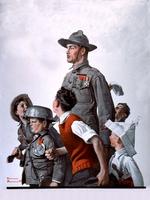
Soldier and comrads
Norman Rockwell
The Palace (2)
Fernando Botero
Part of a Series Chronicling the Uniforms of Napoleon's Grande Armée.
Carle Vernet
Le Curassier
Gustave Neymark