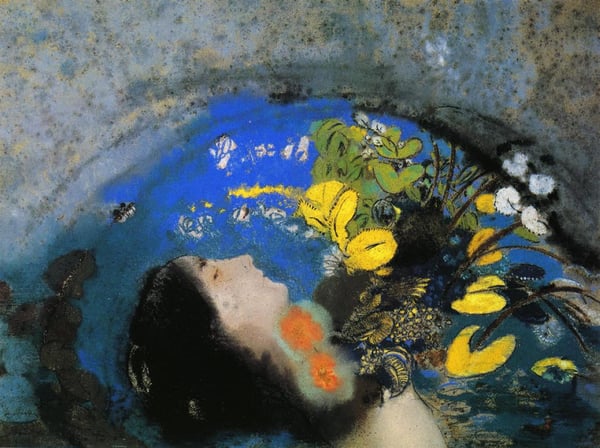
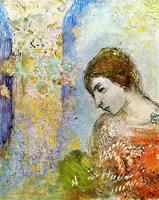
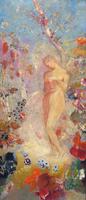
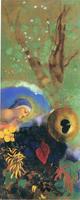
"Ophelia" by Odilon Redon exemplifies the Symbolist movement's break from naturalism, transforming a familiar literary subject—the drowned Ophelia from Shakespeare's Hamlet—into a private, dreamlike vision. Rather than illustrating the scene with historical or descriptive accuracy, Redon uses muted, etherial colors and simplified forms to evoke the psychological state of the tragic heroine. The painting's significance lies in its rejection of literal narrative in favor of mood and symbolic suggestion: Ophelia is not a figure in a landscape but an emblem of melancholy, transience, and the fusion of life and death. This approach aligns with Symbolism's core aim—to express inner realities through metaphor and imagination—and marks Redon as a key pioneer in shifting painting away from realism toward the poetic and the subconscious.