Expert Analysis of Odilon Redon’s "Upon awakening I saw the Goddess of the Intelligible with her severe and hard profile"
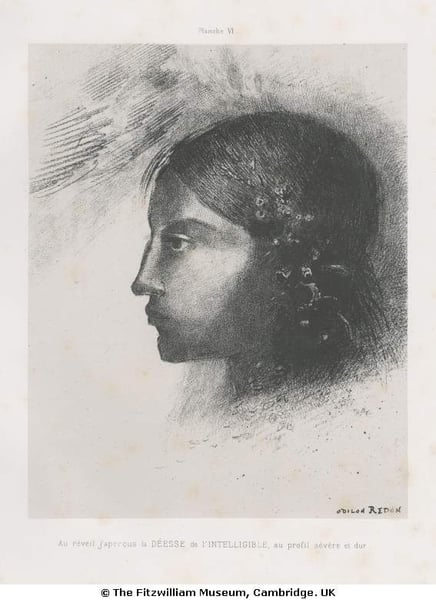
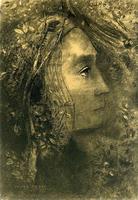
This enigmatic work by Odilon Redon exemplifies the core principles of the Symbolist movement, rejecting the literal representation of the external world in favor of an inward, dreamlike vision. Its significance lies in how it transforms a philosophical or psychological concept—the "Intelligible" (reason, order, or absolute knowledge)—into a haunting, almost contradictory visual presence. The title itself is a poetic statement, describing an epiphany upon waking, a liminal state between sleep and consciousness where the boundaries of reality blur.
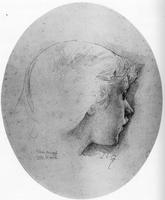
The "Goddess" is described as having a "severe and hard profile," which contrasts with traditional depictions of divine beings as soft or benevolent. In Symbolist fashion, Redon materializes an abstract idea (intelligibility) as a stern, unyielding figure, suggesting that pure reason is both awe-inspiring and intimidating. The artwork’s significance stems from its ability to evoke the tension between the known and the unknown, the rational and the irrational—a central preoccupation of Symbolism. By rendering the goddess with severe features, Redon implies that the pursuit of clarity or truth may be rigorous and unfeeling, challenging the viewer to confront the unsettling nature of intellectual awakening.
As a symbolic painting, it operates not through narrative but through suggestive imagery. Redon’s use of form, likely with his characteristic muted tones and charcoal or pastel handling, would emphasize the spectral, evanescent quality of the vision. The work stands as a landmark of Symbolist art because it prioritizes subjective experience and metaphorical meaning over factual description, inviting endless interpretation. Its title and image together create a riddle, fitting for an era that sought to capture the ineffable.