Pierre-Paul Prud'hon の Adonis の専門的な分析
スタイル:Neoclassicism · ジャンル:sketch and study
Expert Analysis of "Adonis" by Pierre-Paul Prud'hon
Significance within Neoclassicism and its Transition to Romanticism
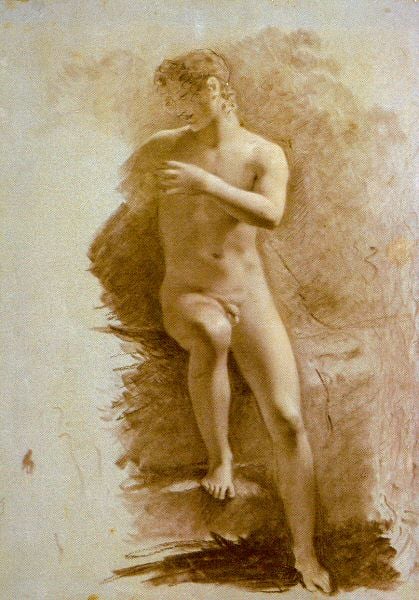
Pierre-Paul Prud'hon's "Adonis" stands as a compelling exemplar of the nuanced evolution within French Neoclassicism at the turn of the 19th century. While the work is categorized as a sketch and study—a preparatory exploration rather than a finished painting—its importance lies precisely in how it reveals Prud'hon's unique synthesis of Neoclassical discipline with a nascent Romantic sensitivity.
1. The Idealized Human Form in a Sketch Neoclassicism prized clarity, line, and the idealized anatomy derived from Greco-Roman sculpture. As a sketch of the mythological youth Adonis, this artwork demonstrates Prud'hon's rigorous adherence to those principles: the figure is likely rendered with a clean, flowing contour that emphasizes proportion and graceful posture. Sketches were the backbone of Neoclassical practice—a laboratory for perfecting form before committing to a final composition. However, unlike the hard, linear precision of a Davidian drawing, Prud'hon's study introduces a softer chiaroscuro and a more ethereal modeling of flesh, suggesting light through subtle gradations rather than harsh contrast.
2. Bridging Neoclassicism and Romanticism Prud'hon is often described as a "proto-Romantic" within the Neoclassical fold. In "Adonis," this manifests in the choice of subject: Adonis, the mortal beloved of Aphrodite, evokes themes of tragic beauty, fleeting youth, and sensuality—elements that Romanticism would later fully embrace. The sketch format enhances this sense of immediacy and emotion; the unfinished, flowing lines convey movement and vulnerability, as if capturing the very breath of the dying god. This emotional undercurrent, combined with a delicate handling of chalk or graphite, set Prud'hon apart from the more austere Neoclassicists. His work influenced later Romantic painters by prioritizing poetic mood over historical narrative.
3. The Status of the Study in Artistic Practice In the academic hierarchy of the period, sketches were often private works—evidence of the artist's genius and manual facility. "Adonis" as a study is significant because it offers a direct window into Prud'hon's creative process. The visible pentimenti (reworked lines) and the economy of means with which he suggests anatomy and drapery reveal the rapid, intuitive decisions of a master draftsman. This transparency makes the study not merely a preparatory tool but an autonomous work of art, valued for its spontaneity and the intimacy of the artist's touch.
Conclusion Pierre-Paul Prud'hon's "Adonis" is significant as a transitional work that upholds Neoclassical ideals while advancing a softer, more emotionally resonant approach that would herald Romanticism. The sketch genre allows us to appreciate both the intellectual control of classicism and the fleeting, sensuous beauty that Prud'hon uniquely captured—a fusion that makes this study a subtle but pivotal artifact in the history of early 19th-century art.
視覚的に類似
構図やパレットが近い作品 20 件
Female Nude Leaning
Pierre-Paul Prud'hon
Standing Female Nude
Pierre-Paul Prud'hon
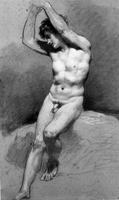
Seated Male Nude
Pierre-Paul Prud'hon
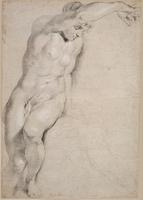
Psyche
Peter Paul Rubens
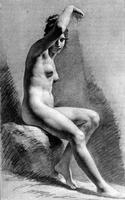
Female Nude Raising her Arm
Pierre-Paul Prud'hon
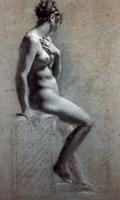
Seated Female Nude
Pierre-Paul Prud'hon
Nude Man Seated
Thomas Eakins
Male nude
Paul Mathiopoulos
Female Nude Bound
Pierre-Paul Prud'hon
Seated Nude Figure
Pierre-Paul Prud'hon
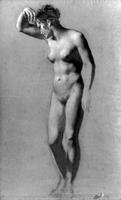
Female Nude
Pierre-Paul Prud'hon
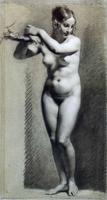
Drawing of Female Nude with charcoal and chalk
Pierre-Paul Prud'hon
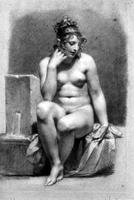
Seated Female Nude by a Fountain
Pierre-Paul Prud'hon
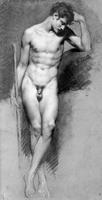
Academic Male Nude
Pierre-Paul Prud'hon
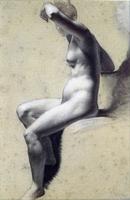
Drawing of Female Nude with charcoal and chalk
Pierre-Paul Prud'hon
Study for Eve
Henri Fantin-Latour
Male nude with victory symbol in his hand
Marià Fortuny
Seated Nude Male
Anton Raphael Mengs
Seated Nude
Francois Boucher
Male Nude Turning
Pierre-Paul Prud'hon