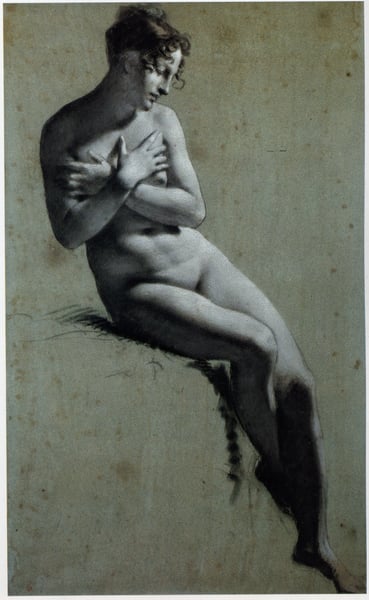
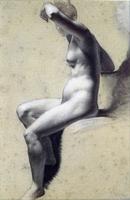
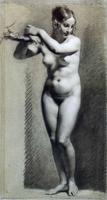
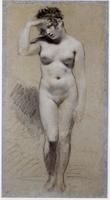
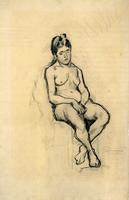
Drawing of Female Nude with charcoal and chalk
Dettagli
Analisi esperta di Drawing of Female Nude with charcoal and chalk di Pierre-Paul Prud'hon
Stile: Neoclassicism · Genere: nude painting (nu)
Expert Analysis: "Drawing of Female Nude with charcoal and chalk" by Pierre-Paul Prud'hon
This drawing is a quintessential example of Pierre-Paul Prud'hon's unique position within Neoclassicism—a period typically associated with crisp lines, stoic grandeur, and archaeological precision. Prud'hon, however, infused his neoclassical forms with a soft, atmospheric quality that anticipates the emotional warmth of Romanticism, making his work a pivotal bridge between the two movements.
-
Technical Mastery and Medium: The choice of charcoal and chalk is significant. Charcoal allows for deep, velvety blacks and fluid, broad strokes, while chalk (often white) introduces luminous highlights and subtle gradations. Prud'hon exploits this combination to create a sfumato‑like effect—a delicate blurring of contours reminiscent of Correggio and Leonardo da Vinci, whom he deeply admired. This technique gives the female nude a palpable, breathing presence, as if emerging from shadow into light, rather than being rigidly outlined.
-
Neoclassical Ideals, Romantic Sensibility: The subject—the female nude (nu)—is a hallmark of Neoclassicism, echoing Greco-Roman sculptural ideals of proportion and grace. Yet Prud'hon departs from the severe, polished finish of contemporaries like Jacques-Louis David. Here, the body is rendered with a sensuous, almost ethereal softness; the tilt of the head, the relaxed contrapposto, and the gently modelled limbs evoke a dreamlike introspection. This emotional intimacy, combined with the classical canon, distinguishes his work as “Neoclassicism adouci”—softened classicism—and underscores the artist’s belief that ideal beauty could be expressed through tenderness rather than austerity.
-
Significance Within the Period: Prud'hon’s nudes were celebrated for their poetic, mutable chiaroscuro, which influenced later Romantic artists such as Eugène Delacroix. This particular drawing likely served as a study for a larger composition or as a finished work in its own right—common in his practice, where the sketch was elevated to a highly refined art form. The work’s significance lies in its demonstration that Neoclassical draftsmanship could accommodate vulnerability and lyricism, challenging the rigid dogma of the era and paving the way for a more expressive approach to the human figure.
In summary, “Drawing of Female Nude with charcoal and chalk” is significant not only as a masterclass in tonal rendering but as a testament to Prud'hon’s role as a transitional figure—one who married the discipline of Neoclassicism with the nascent stirrings of Romantic feeling.
Genere
Stile
Visivamente simili
20 opere con composizione e palette affini
Seated Female Nude
Pierre-Paul Prud'hon
Female Nude Leaning
Pierre-Paul Prud'hon
Drawing of Female Nude with charcoal and chalk
Pierre-Paul Prud'hon
Standing Nude
Zinaida Serebriakova
Nude Seated with Arms Joined and Resting on a Support
Jules Olitski
Bathing Venus
Pierre-Paul Prud'hon
Female nude
Paul Mathiopoulos
Drawing of Female Nude with charcoal and chalk
Pierre-Paul Prud'hon
Female Nude Raising her Arm
Pierre-Paul Prud'hon
Seated Female Nude
Adolf Hirémy-Hirschl
Solitudine
Adolf Hirémy-Hirschl
Standing Female Nude
Pierre-Paul Prud'hon
Seated woman
Pablo Picasso
Female Nude from Behind
Pierre-Paul Prud'hon
Study for ''The dance of the Bacchantes''
Charles Gleyre
The Source
Pierre-Paul Prud'hon
Female Nude
Pierre-Paul Prud'hon
Drawing of Female Nude with charcoal and chalk
Pierre-Paul Prud'hon
Seated Female Nude
Vincent van Gogh
Nude with tree
Mario Sironi