Expertenanalyse zu Pierre-Paul Prud'hons Male Nude Raising his Arm
Stil: Neoclassicism · Genre: nude painting (nu)
Artwork Analysis: "Male Nude Raising his Arm" by Pierre-Paul Prud’hon (c. 1800–1810)
Style: Neoclassicism | Genre: Nude study (nu)
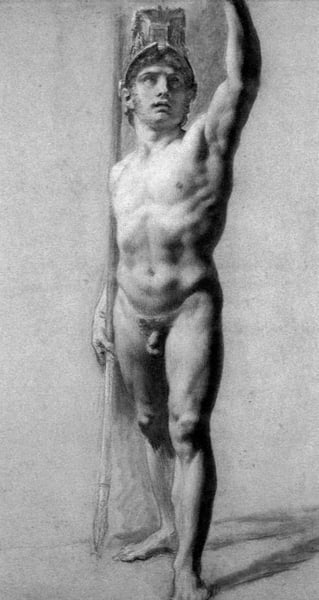
Pierre-Paul Prud’hon’s Male Nude Raising his Arm is a compelling example of how Neoclassical idealism could be infused with a softer, more atmospheric sensibility, foreshadowing Romanticism. While rooted in the academic tradition of the nu (life-drawing study), the work distinguishes itself through its masterful chiaroscuro and subtle emotional charge. The raised arm creates a dynamic diagonal that breaks the static, frieze-like poses typical of strict Neoclassicism, introducing a sense of latent movement and psychological tension.
Prud’hon’s handling of the male form is both idealized and sensuous. The anatomy is rendered with precision—the ripple of the torso, the tension in the shoulder—but the transitions are softened by a sfumato-like blending of light and shadow. This technique, reminiscent of Leonardo da Vinci, softens the marble-hard surfaces of Davidian Neoclassicism, giving the figure a palpable, living warmth. The dark, undefined background isolates the torso, forcing the viewer to focus on the interplay of light across the musculature—a hallmark of Prud’hon’s ability to merge classical form with dramatic, moody illumination.
Significantly, this work represents a bridge between two eras. Prud’hon was a contemporary of Jacques-Louis David, yet his nudes often carry a melancholic, introspective quality absent from David’s civic-minded classicism. The raised arm here is not a rhetorical gesture of heroism (as it might be in a Davidian history painting) but a reflexive, almost vulnerable act—as if the figure is stretching, recoiling, or reaching for something unseen. This ambiguity aligns Prud’hon with the emerging Romantic fascination with individual physical experience over public virtue.
In the context of Neoclassicism, Male Nude Raising his Arm is significant because it demonstrates that the style was not monolithic. Prud’hon proves that Neoclassical discipline could coexist with a lyrical, painterly approach—one that emphasized the intimate, corporal reality of the nude rather than its symbolic or civic role. The painting thus stands as a crucial precursor to the more overtly expressive nudes of Géricault and Delacroix, while still honoring the classical ideal of harmonious proportion.
Museum / Gallery
Visuell ähnlich
20 Werke mit ähnlicher Komposition und Farbpalette
Male Nude Pointing
Pierre-Paul Prud'hon
Naked man with spear
Marià Fortuny
Étude Pour Le Retour Du Fils Prodigue
Charles Gleyre
Male nude
Gustave Moreau
Academic Male Nude
Pierre-Paul Prud'hon
Étude De Nu Masculin
Eugène Jansson
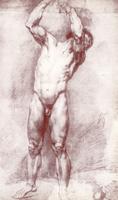
Sitter
Orest Kiprensky
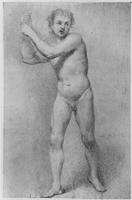
Nude Study of a striding man with stone sling
Allan Ramsay
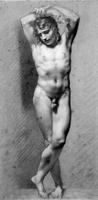
Academic Male Nude
Pierre-Paul Prud'hon
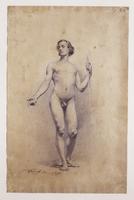
Nude young man with spear
Marià Fortuny
A standing male nude, seen in profile, turned to the right
Francois-Bernard Lepicie
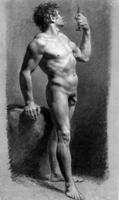
Male Nude Turning
Pierre-Paul Prud'hon
Nude front male with disc
Marià Fortuny
Academic Male Nude
Pierre-Paul Prud'hon
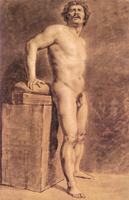
Male Academy Figure
Eugene Delacroix
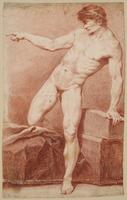
Männerakt
Charles-Andre van Loo (Carle van Loo)
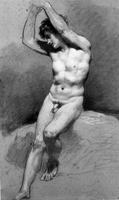
Seated Male Nude
Pierre-Paul Prud'hon
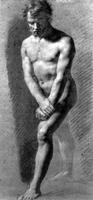
Male Nude Grasping his Wrists
Pierre-Paul Prud'hon
Sitter
Orest Kiprensky
Nude 2
John Singer Sargent