
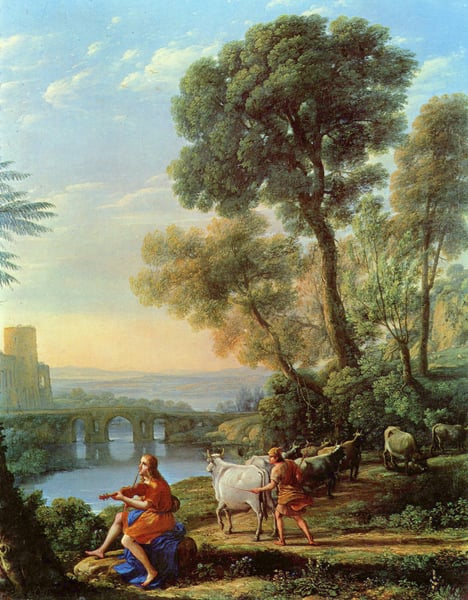
Analisi esperta di Landscape with Apollo Guarding the Herds of Admetus di Claude Lorrain
Stile: Classicism · Genere: mythological painting
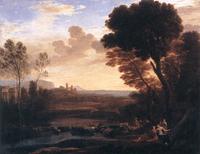
Claude Lorrain’s Landscape with Apollo Guarding the Herds of Admetus is a quintessential example of Classicism in landscape painting, demonstrating the artist’s profound influence on the development of the idealized, heroic landscape genre. Painted in the mid‑17th century, the work transcends its mythological narrative—Apollo’s punishment for killing the Cyclops, serving as a mortal herdsman—to celebrate the harmonious balance between human figures and an ordered, luminous nature.
Significance within Classicism:
Lorrain elevates the landscape from a mere backdrop to the primary subject, structuring the composition with a rigorous classical order. The scene is divided into distinct foreground, middle ground, and distance, using repoussoir elements (trees, ruins) to frame a deep, atmospheric vista. This spatial clarity, combined with a warm, golden light that suffuses the entire canvas, reflects the classical ideal of concinnitas (harmonious proportion). The mythological figures of Apollo and the herds are deliberately small, subsumed into the grandeur of nature, emphasizing humanity’s subordinate place within a rational, timeless universe.
Mastery of Light and Atmosphere:
Lorrain’s handling of light is the painting’s most revolutionary aspect. The low, raking sunlight illuminates the landscape with a soft, golden glow, creating a sense of tranquility and eternal afternoon. This treatment of light—often called la lumière de Claude—was a defining influence on later artists such as J. M. W. Turner and the British landscape tradition. The subtle gradations of tone and color, from the dark greens of the foreground to the hazy blues of the distant mountains, demonstrate his pioneering use of aerial perspective to unify the scene.
Mythology as Justification for Landscape:
While the subject is drawn from Ovid’s Metamorphoses, Lorrain uses the myth as a pretext for an idealized pastoral vision. Apollo, the god of music and order, becomes a shepherd—an allegory of the civilizing power of art and reason over untamed nature. The composition’s serene symmetry, with a central waterway leading the eye to a sunlit horizon, reinforces this theme of harmonious control. The classical ruins in the foreground further anchor the scene in a golden age of antiquity, making the landscape itself a symbol of timeless, universal beauty.
Why It Matters:
This painting is significant because it codifies the classical landscape—one where nature is perfected, lit by a unifying light, and structured according to rational principles. It influenced generations of painters, from the French Academy to the Romantic era, and remains a touchstone for the ideal of nature as a mirror of human order and divine harmony. Lorrain’s Landscape with Apollo Guarding the Herds of Admetus is not merely a mythological scene; it is a manifesto for landscape as a vehicle for the noblest aspirations of Classicism.
Museum / Gallery
Visivamente simili
20 opere con composizione e palette affini
Landscape with the finding of Moses
Claude Lorrain
Landscape with Cephalus and Procris Reunited by Diana
Claude Lorrain
Rest on the Flight into Egypt
Claude Lorrain
Landscape with Flight into Egypt
Claude Lorrain
Landscape with the Flight into Egypt
Claude Lorrain
Diogenes Throwing away His Bowl (afrer Nicolas Poussin)
George Lambert
Landscape with the Rest on The Flight into Egypt
Claude Lorrain
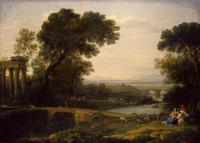
Landscape with Rest in Flight to Egypt
Claude Lorrain
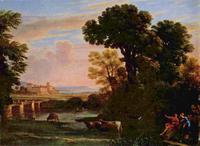
Pastoral Landscape
Claude Lorrain
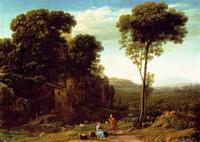
Pastoral Landscape with a Mill
Claude Lorrain
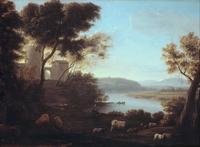
The Roman Campagna
Claude Lorrain
Landscape with Water Mill
Claude Lorrain
Pastoral landscape
Claude Lorrain
Pastoral Landscape
Claude Lorrain
Arcadian landscape with a bust of Flora
Jan van Huysum
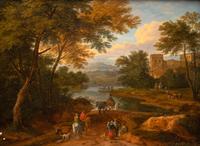
Landscape with travellers
Adriaen Frans Boudewyns
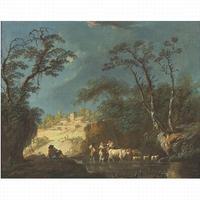
Landscape
Jean Baptiste Pillement
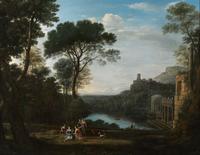
Landscape with the Nymph Egeria
Claude Lorrain
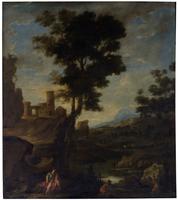
Landscape with Leto and the Peasants Transformed into Frogs
Benito Manuel Agüero
Landscape with Paris and Oenone
Claude Lorrain