Analisi esperta di Last Supper di Domenico Ghirlandaio
Stile: Early Renaissance · Genere: religious painting
Expert Analysis of Last Supper by Domenico Ghirlandaio (Early Renaissance)
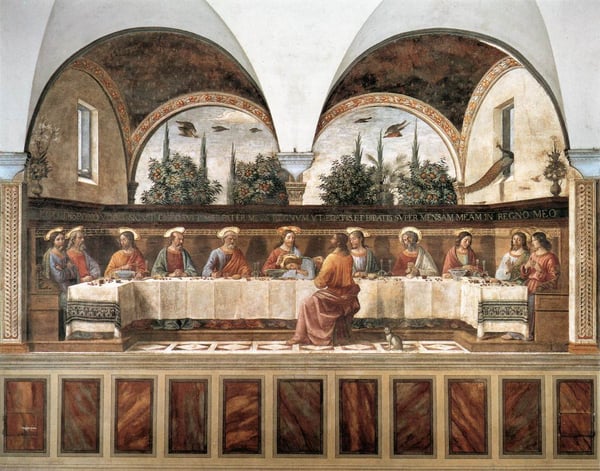
As an Early Renaissance religious fresco painted around 1480 for the refectory of the Convent of Ognissanti in Florence, Ghirlandaio's Last Supper is a landmark of naturalistic storytelling and spatial clarity. Its significance lies in how it bridges the late Gothic tradition of narrative detail with the emerging Renaissance ideals of perspective, human emotion, and domestic realism.
Key Elements of Significance
-
Mastery of Linear Perspective and Spatial Depth
Ghirlandaio constructs a convincing, receding interior using a single vanishing point centered behind Christ’s head. The coffered ceiling, tiled floor, and side walls create a measurable, symmetrical space that draws the viewer’s eye into the scene—a hallmark of Early Renaissance mathematical perspective. This precision anchors the sacred drama in a believable, contemporary setting. -
Integration of Still Life and Domestic Realism
Unlike earlier, more symbolic depictions, Ghirlandaio populates the table with meticulously rendered objects: a salt cellar, cut pomegranates, bread, and wine vessels. A cat sits at the left, a dog behind Judas (who is isolated on the near side of the table), and birds perch on a ledge. These details—often overlooked in later, more iconic Last Supper paintings—reflect the Early Renaissance fascination with the natural world and everyday life. They also serve symbolic roles: the cat may imply temptation or the devil, while the dog traditionally represents fidelity. -
Narrative and Psychological Clarity
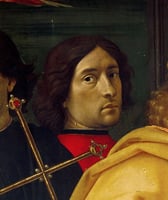
Unlike Leonardo’s later explosive reaction, Ghirlandaio’s apostles react with restrained gestures and calm groupings. Christ’s hand reaches toward John, who leans in, while Judas reaches across the table—his identity clearly marked by his isolated position and lack of a halo. The composition prioritizes legibility over drama: each apostle is a distinct, individualized portrait, likely based on local Florentine citizens. This humanization of biblical figures exemplifies the Renaissance shift from hieratic symbolism to empathetic, character-driven storytelling. -
Fresco Technique and Influence
Ghirlandaio’s Last Supper was executed in fresco with remarkable speed and confidence, showcasing his skill in buon fresco (true fresco). The luminous pastel palette and soft modeling of drapery anticipate the work of his young apprentice, Michelangelo, who would have absorbed Ghirlandaio’s attention to natural light and bodily mass. The painting also directly influenced later refectory frescoes, including Leonardo’s more famous version at Santa Maria delle Grazie, which reinterprets the same subject with greater psychological tension. -
Ghirlandaio’s Role in Florentine Art
As one of the most sought-after fresco painters of his time, Ghirlandaio combined devotional content with an almost journalistic eye for contemporary Florentine life. His Last Supper is not merely a biblical illustration but a snapshot of late-15th-century domesticity, complete with period costumes, tableware, and architecture. This blend of the sacred and the everyday made his work accessible to his monastic patrons and lay viewers alike, bridging faith and the burgeoning humanist curiosity of the age.
Conclusion
Ghirlandaio’s Last Supper is significant not for revolutionary innovation but for its synthesis—perspective, naturalism, narrative clarity, and symbolic detail—executed with a masterful fresco hand. It stands as a quintessential Early Renaissance religious work that prepares the ground for the High Renaissance while remaining a vivid document of its own time. Its quiet power lies in making the divine feel intimately, concretely present.
Visivamente simili
20 opere con composizione e palette affini
Last Supper
Domenico Ghirlandaio
Last Supper
Domenico Ghirlandaio
The Last Supper
Andrea del Castagno
The Feast of Herod: Salome's Dance
Filippo Lippi
Last Supper (Carmine, Florence)
Alessandro Allori
Life of St Benedict, Scene 31. Benedict Feeds the Monk
Il Sodoma
Institution of the Eucharist
Fra Angelico
Herod's Banquet
Domenico Ghirlandaio
The Last Supper
Andrea del Sarto
Life of St. Benedict. Benedict Tells Two Monks What They Have Eaten
Luca Signorelli
Life of St Benedict, Scene 3. Benedict Repairs a Broken Colander Through Prayer
Il Sodoma
Tabernacle of the Visitation: Expultion of Joachim from the Temple
Benozzo Gozzoli
Life of St Benedict, Scene 11. Benedict Founds Twelve Monasteries
Il Sodoma
The Confirmation of the Olivetan Order by the Bishop of Arezzo
Il Sodoma
Christ among the Doctors
Pinturicchio
Angel Appearing to Zacharias
Domenico Ghirlandaio
The Last Supper (detail)
Andrea del Sarto
Announcement of Death to St. Fina
Domenico Ghirlandaio
Rinuccini Chapel (basilica of Santa Croce)
Giovanni da Milano
Life of St Benedict, Scene 19. Benedict Sends Away the Harlots
Il Sodoma