Analisi esperta di Cathedral of Freiburg in Switzerland di August Macke
Stile: Expressionism · Genere: cityscape
Expert Analysis: "Cathedral of Freiburg in Switzerland" by August Macke
Significance within Expressionism and the Cityscape Genre
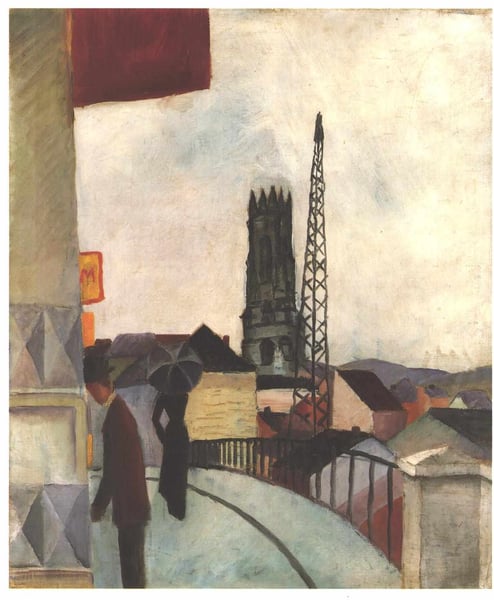
August Macke’s Cathedral of Freiburg in Switzerland stands as a luminous synthesis of Expressionist color theory and the urban landscape, representing a pivotal moment in early 20th-century German painting. As a key member of the Der Blaue Reiter group, Macke transformed the traditional cityscape from a documentary view into a visceral, emotional experience.
1. Color as Spiritual and Emotional Force
Macke elevates color beyond mere representation, using bold, non-naturalistic hues to evoke the cathedral’s spiritual aura. The church does not appear in factual grays or browns; instead, it is rendered in vibrant blues, purples, and yellows, pushing the scene toward a transcendent harmony. This approach aligns with Expressionism’s core goal—to convey inner feeling rather than outer reality. Macke’s palette here is notably influenced by Robert Delaunay’s Orphism, but he tempers that chromatic intensity with a distinctly lyrical, peaceful tone.
2. Simplified Form and Movement
Geometric simplification defines the cathedral’s architecture: the spires and nave are reduced to faceted, almost faceted shapes, echoing the contemporaneous influence of Cubism. Yet Macke avoids fragmentation; his lines remain rhythmic and flowing, guiding the eye upward and suggesting a sense of spiritual ascension. The surrounding cityscape is rendered in broad, flat planes, with figures and trees simplified into decorative patterns—a hallmark of Macke’s mature style, where form becomes a vehicle for pure visual rhythm.
3. Integration of Nature and Urban Structure
Unlike many Expressionist cityscapes that emphasize anxiety or alienation, Macke’s cathedral nestles harmoniously within its natural setting. Green trees and blue sky interlock with the structure’s vertical thrust, implying a unity between the divine, the human, and the organic world. This reflects Macke’s belief that art could reveal a cosmic harmony underlying everyday life.
4. Historical & Stylistic Importance
Painted around 1913–1914, shortly before Macke’s death in World War I, this work represents the apex of his exploration of light and color. It demonstrates how Expressionism could reshape sacred architecture not as a somber monument but as a vibrant, living presence. The painting bridges German Expressionist subjectivity with the crystalline clarity of French modernism, making it a key example of the cross-cultural exchanges that defined the pre-war avant-garde.
In summary, Cathedral of Freiburg in Switzerland is significant for its masterful use of expressive color to transform a cityscape into a vision of spiritual and aesthetic harmony. It exemplifies August Macke’s unique ability to make the urban environment sing with color and emotion, securing his place as one of Expressionism’s most poetic innovators.
Visivamente simili
20 opere con composizione e palette affini
Dunkirk, the Fishing Docks
Camille Corot
The Church of St. Mary in Bonn in Snow
August Macke
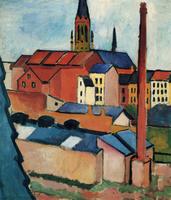
St. Mary's with Houses and Chimney (Bonn)
August Macke
Dunkirk, Festival Day
Eugene Boudin
The Roofs of Old Rouen Grey Weather
Camille Pissarro
Bucharest Landscape
Lucian Grigorescu
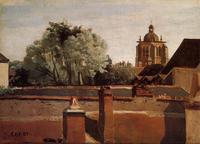
Bell Tower of the Church of Saint Paterne at Orleans
Camille Corot
Landscape with Figure
Joaquín Sorolla
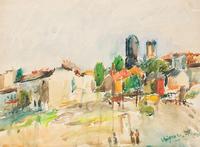
View Towards Sf. Spiridon Church
Lucian Grigorescu
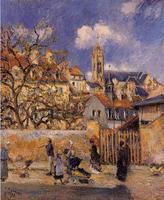
The Park in Charrettes, Pontoise
Camille Pissarro
Our street with horse riding, Bonn
August Macke
Brussels Town Hall
James Ensor
Orleans, View from a Window Overlooking the Saint Peterne Tower
Camille Corot
The Church at Essoyes
Pierre-Auguste Renoir
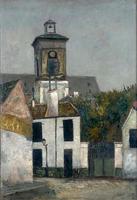
Chuch of Saint Margerit in Paris
Maurice Utrillo
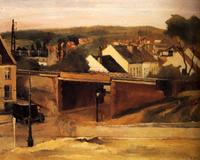
For Auderghem
Paul Delvaux
Galimberti Sándor , Párizsi Háztetők, 1912
Galimberti Sándor
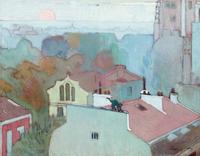
Berény Róbert, Esti Hangulat 1905
Berény Róbert
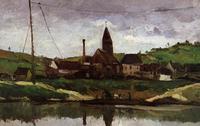
View of Bonnieres
Paul Cezanne
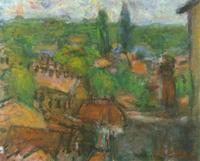
Paysage
Bela Czobel