Expert analysis of August Macke’s St. Germain near Tunis
Style: Expressionism · Genre: cityscape
Expert Analysis: St. Germain near Tunis by August Macke
Context and Significance
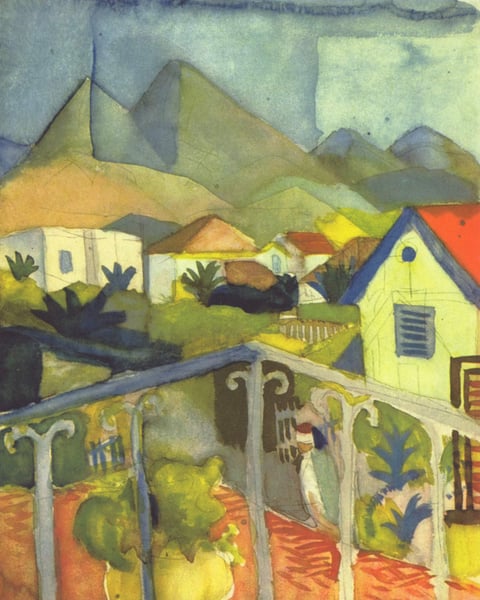
Painted in 1914 during August Macke’s transformative trip to Tunisia alongside Paul Klee and Louis Moilliet, St. Germain near Tunis represents a pinnacle of German Expressionism’s engagement with light, color, and non-European topography. This journey proved to be a creative zenith for Macke—shortly before his death in World War I—and this work exemplifies his unique ability to fuse the emotional intensity of Expressionism with the luminous, structural clarity inspired by Fauvism and Cubism.
Stylistic Innovations
As an Expressionist cityscape, the painting departs from the movement’s typical angst and dislocation. Instead, Macke achieves a radiant, harmonious vision of urban life through bold, unmodulated swaths of color—vivid oranges, blues, and greens—that define architectural forms and shadow without naturalistic shading. The composition is built from simplified geometric planes (reminiscent of Robert Delaunay’s Orphism) yet retains a buoyant, rhythmic energy. Macke’s use of watercolor-like translucency, even in oil, captures the intense North African sunlight, saturating the streets and domed buildings with a near-abstract glow.
Significance within Expressionism
St. Germain near Tunis is significant for demonstrating that Expressionism need not be solely psychological or dark. Macke’s palette communicates joy, serenity, and a sense of spiritual unity with the environment—qualities that align with Der Blaue Reiter’s interest in the symbolic and the transcendent. The work also crystallizes Macke’s mature style: a synthesis of the Fauves’ liberated color, the Cubists’ faceted space, and the Expressionist quest for inner truth. In its confident, lyrical abstraction of a real place, the painting stands as a testament to Macke’s belief that art could capture the “rhythm of the cosmos” in everyday scenes. Today, it is celebrated as a masterpiece of pre-war Expressionism and a poignant farewell to an era of optimism before the catastrophe of 1914.
Visually similar
20 works with related composition and palette
Brazilian Landscape
Lasar Segall
Cagnes
Bela Czobel
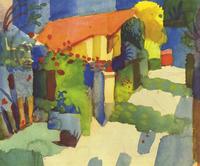
House in the garden
August Macke
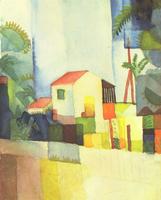
Bright House
August Macke
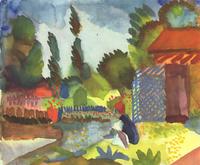
Tunis landscape with a sedentary Arabs
August Macke
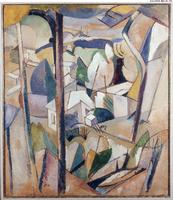
Untitled
Albert Gleizes
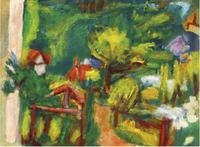
Summer Memories
Bela Czobel
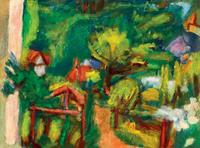
Czóbel Béla , Táj Házakkal 1930
Bela Czobel
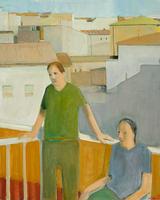
Couple on the Balcony
Henry Villierme
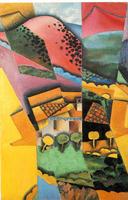
Landscape at Ceret
Juan Gris
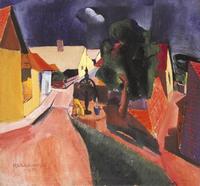
Street at Szentendre in Stormy Weather
Istvan Ilosvai Varga
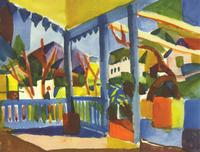
Terrace of the country house in St. Germain
August Macke
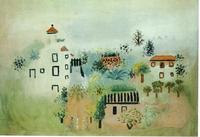
Landscape
Pablo Picasso
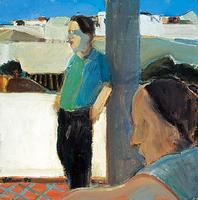
A Quiet Moment
Henry Villierme
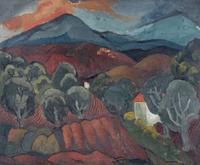
Landscape at Vence
Christopher Wood
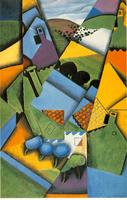
Landscape with House at Ceret
Juan Gris
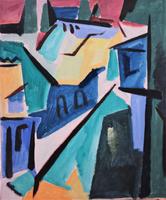
Gurzuf
Volodymyr Loboda
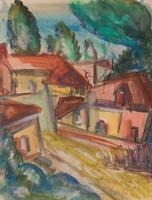
Du Village
Bela Czobel
Garden on Lake Thun
August Macke
Mirmande jaune
André Lhote