Analisi esperta di Turkish Cafe (II) di August Macke
Stile: Fauvism · Genere: genre painting
Expert Analysis of "Turkish Cafe (II)" by August Macke
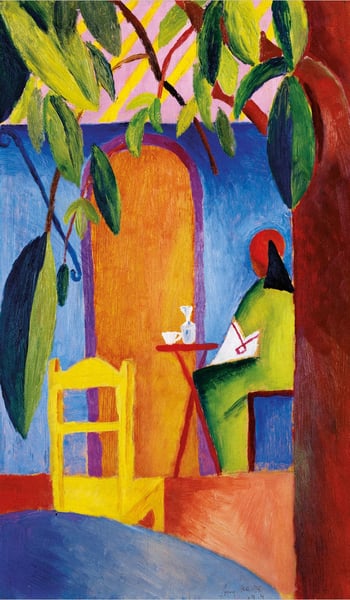
As a genre painting executed in the Fauvist style, Turkish Cafe (II) stands as a vivid testament to August Macke’s absorption of Fauvist principles—particularly the use of bold, non-naturalistic color and simplified form—while prefiguring his later role within the Expressionist movement. The work’s significance lies in how it translates the Fauvist emphasis on pure, expressive color into an intimate, everyday scene, infusing the exotic orientalist subject with a modern, chromatic vibrancy.
Fauvist Hallmarks:
Macke employs the movement’s signature palette of saturated, unmixed hues—bright yellows, deep blues, and fiery reds—to evoke the sensory thrill of a Turkish cafe rather than to replicate its literal appearance. The figures and architecture are reduced to essential, flat planes of color, eliminating naturalistic shading in favor of emotional intensity. This aligns with Fauvism’s overarching goal: to liberate color from descriptive function and let it carry the painting’s mood and structure.
Genre-Specific Significance:
By choosing a cafe interior—a mundane, social space—Macke applies Fauvist radicalism to the traditions of genre painting. Unlike earlier Realist or Impressionist treatments of cafes (e.g., Degas or Manet), Macke’s scene does not aim for atmospheric fidelity or psychological depth. Instead, he transforms the cafe into a kaleidoscope of decorative patterns and flat color patches, dissolving depth into a surface tapestry. This approach anticipates the more abstracted, lyrical works of Der Blaue Reiter, which Macke would later co-found.
Bridging Movements:
Turkish Cafe (II) is significant because it demonstrates how Fauvism’s lessons were assimilated into German Expressionism. Macke’s borrowing of Fauvist color autonomy, combined with a spirited, exoticized subject, reveals a transitional moment: the cafe becomes a stage for pure visual delight, foreshadowing the spiritual and expressive aims that would define his later output. The painting’s joyful, unmodulated palette and deliberate naiveté mark it as a key example of early 20th-century European modernism’s embrace of color as the primary conveyor of meaning.
Visivamente simili
20 opere con composizione e palette affini
Turkish Cafe (I)
August Macke
The Patio, Nerja
Stanley Pinker
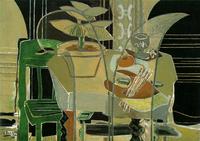
Interior with Palette
Georges Braque
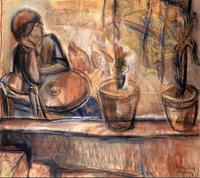
Egry József, Annuska
Egry József
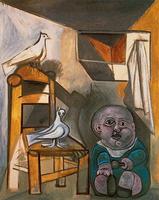
A child with pigeons
Pablo Picasso
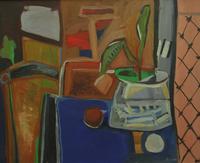
Untitled
Dilek Demirci
Children with goldfish bowl
Paula Modersohn-Becker
Still Life
Auguste Herbin
At the Garden Table
August Macke
Two friends
Nikos Hadjikyriakos-Ghikas
Still-life on a Table of Horseshoe Form
Vajda Lajos
Paysage--l'homme dans la ville
Leopold Survage
Little Sweet
William H. Johnson
Woman reading
Pablo Picasso
Little Girl in Orange
William H. Johnson
Small Interior with Round Marble Table
Henri Matisse
Still Life In blue
Adriana Naveh
Interior with fruit bowl
Raoul Dufy
Scheiber Hugó, Szoba Belső
Scheiber Hugó
Anna MArgit, Angyali Üdvözlet
Anna Margit