Expertenanalyse zu Jacob Jordaenss Neptune Creating the Horse
Stil: Baroque · Genre: mythological painting
Expert Analysis of "Neptune Creating the Horse" by Jacob Jordaens
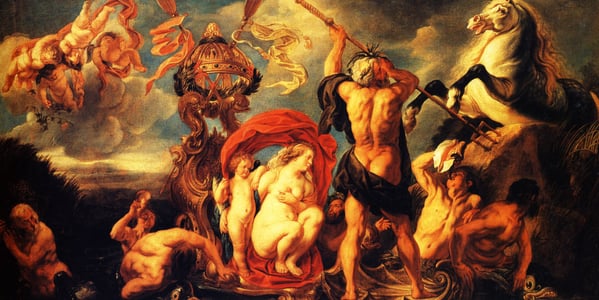
Jacob Jordaens’ Neptune Creating the Horse is a quintessential Baroque mythological painting that captures the dramatic energy and emotional intensity characteristic of the 17th-century Flemish school. The work draws on a classical myth: Neptune (the Roman equivalent of Poseidon) strikes the earth with his trident, and from the ground springs the first horse—a symbol of power, civilization, and the raw force of nature shaped by divine will.
Significance within the Baroque Style
Jordaens masterfully deploys the Baroque hallmarks of dynamic movement, stark chiaroscuro, and a sense of theatrical immediacy. The figure of Neptune is rendered with robust musculature and a twisting, contrapposto pose that conveys both authority and violent creative energy. The horse, bursting forth mid-gallop, anchors the composition’s diagonal thrust—a classic Baroque device that directs the viewer’s eye along a spiraling path of action. Light falls dramatically across the god’s torso and the horse’s mane, heightening the sculptural quality of the forms and emphasizing the miraculous nature of the event.
Mythological Narrative and Allegory
In choosing this rarely depicted moment (Neptune’s invention of the horse rather than his better-known sea triumphs), Jordaens aligns with the Baroque fascination with origin stories and allegorical force. The painting is not merely a spectacle; it embodies the Baroque belief in art as a vehicle for conveying grand themes—creation, dominion, and the taming of nature. Neptune’s calm, commanding expression contrasts with the explosive birth of the animal, suggesting divine wisdom guiding raw instinct.
Placement in Jordaens’ Oeuvre
While often overshadowed by Rubens’ more fluid dynamism, Jordaens brings a distinctive earthiness and psychological weight to this mythological scene. The bold, almost tactile brushwork and the dense, warm palette (rich browns, ochres, and deep blues) ground the myth in a tangible, human-scale reality. This work is significant for demonstrating how Baroque painters could transform a classical fable into a visceral, immediate experience—one that still resonates with the era’s enduring themes of power, creation, and the sublime.
Museum / Gallery
Visuell ähnlich
20 Werke mit ähnlicher Komposition und Farbpalette
The Birth of Venus
Nicolas Poussin
Neptune and Amphitrite in the Storm
Jacob Jordaens
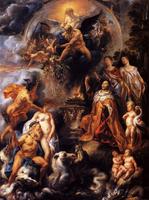
Allegory of the Peace of Westphalia
Jacob Jordaens
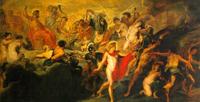
The Council of the Gods
Peter Paul Rubens
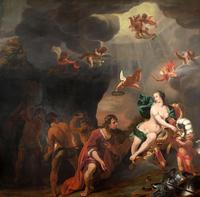
Aeneas Receiving a New Set of Armour from Venus
Ferdinand Bol
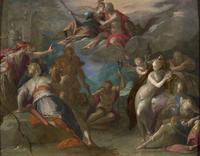
The Amazement of the Gods
Hans von Aachen
Allegory of the Poet
Jacob Jordaens
The Consequences of War
Peter Paul Rubens
Lapiths and the Centaurs
Jacob Jordaens
Messina Returning to Spain
Luca Giordano
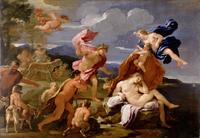
Bacchus and Ariadne
Luca Giordano
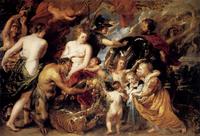
Allegory on the Blessings of Peace
Peter Paul Rubens
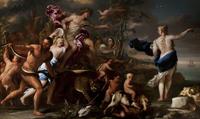
The Triumph of Bacchus and Ariadne
Luca Giordano
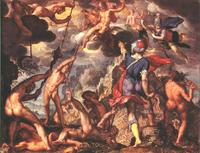
The Battle Between the Gods and the Titans
Joachim Wtewael
Allegory of prosperity
Erasmus Quellinus the Younger
Rinaldo and Armida
Nicolas Poussin
Preparation for the Wedding of Neptune and Amphitrite
Hans Rottenhammer I
Venus and Vulcan
Francois Boucher
L'Enlèvement des Sabines
Theodor van Thulen
The Apotheosis of Aeneas
Jacob Jordaens