Expert analysis of Jacob Jordaens’s The Return from Egypt of the Holy Family
Style: Baroque · Genre: religious painting
Expert Analysis: "The Return from Egypt of the Holy Family" by Jacob Jordaens
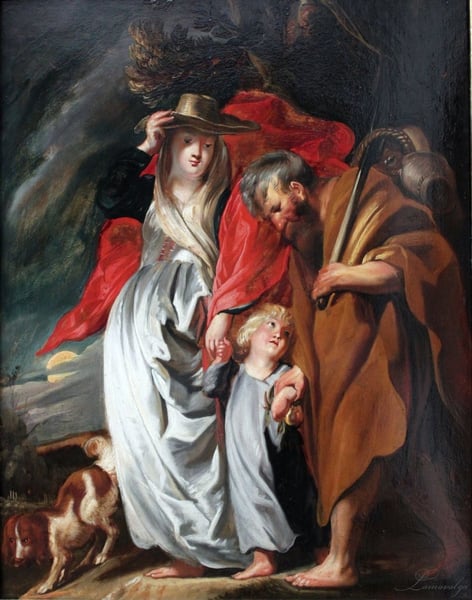
Within the dynamic and emotionally charged world of Flemish Baroque painting, Jacob Jordaens’ The Return from Egypt of the Holy Family stands as a compelling example of religious narrative infused with earthy humanism. Executed in the signature Baroque style, the work draws the viewer into a sacred journey through vigorous composition, rich naturalism, and a palpable sense of divine ordinariness.
Significance within the Baroque Style and Period
-
Dramatic Naturalism and Human Presence: True to Baroque ideals, Jordaens eschews idealized, remote holiness in favor of a deeply relatable Holy Family. The Virgin, Joseph, and the Christ Child are depicted not as ethereal beings but as robust, flesh-and-blood travelers. This focus on tangible, human emotion—the weariness of the journey, the protective tenderness of parents—elevates the biblical scene into a universal experience, a key trait of Counter-Reformation art intended to make the divine accessible to the faithful.
-
Dynamic Composition and Movement: The painting exemplifies the Baroque love for motion and energy. Rather than a static, posed group, Jordaens arranges the figures in a diagonal, forward-moving rhythm. The donkey’s determined stride, the Virgin’s steadying hand, and the child’s curious glance create a sense of pilgrimage in progress. This diagonal thrust draws the eye through the canvas, a hallmark of Baroque dynamism that contrasts with the more stable, centralized compositions of the Renaissance.
-
Vibrant, Earthy Palette and Chiaroscuro: Jordaens applies a rich, warm palette—deep reds, golden browns, and luminous blues—that grounds the holy narrative in the material world. Strong contrasts of light and shadow (chiaroscuro) model the figures with sculptural volume, while the glowing highlights on the Christ Child’s face and Mary’s mantle emphasize their spiritual importance. This interplay of light and darkness is quintessentially Baroque, directing the viewer’s focus to the sacred core amidst the journey’s dust and shadow.
Genre and Narrative Context
As a religious painting, the work draws from the apocryphal and scriptural traditions of the Holy Family’s flight into Egypt (Matthew 2:13-15) and their later return. Rather than focusing on the peril of the initial escape, Jordaens captures a moment of tranquil homecoming—a respite after ordeal. This choice reflects the Baroque preference for "everyday" sanctity: the divine is found not in miraculous spectacle but in the quiet resilience of family life. Jordaens’ characteristic robustness—broad figures, expressive faces, and loose, vigorous brushwork—imbues the scene with a folkloric warmth, making the sacred narrative feel immediate and lived.
Conclusion
The Return from Egypt of the Holy Family is significant as a masterful synthesis of Baroque religious art’s core values: emotional immediacy, dramatic movement, and a profound humanization of biblical subjects. Jacob Jordaens, through his earthy naturalism and dynamic composition, transforms a familiar episode into a vivid, sensual encounter. The painting stands as a testament to the Flemish Baroque’s ability to marry the grandeur of faith with the intimacy of daily life, securing its place as a poignant example of how the Baroque period redefined the sacred in terms of the human.
Visually similar
20 works with related composition and palette
Return of the Holy Family from Egypt
Jacob Jordaens
Adolescent Virgin decorated by Angels in the presence of Joachim and Saint Anne
Gaspar de Crayer
Abraham and Isaac
Anthony van Dyck
Saint Francesca Romana Giving Alms
Giovanni Battista Gaulli
Holy Women at Christ' s Tomb
Annibale Carracci
The Flight into Egypt
Domenico Fiasella
Heilige Familie
Giulio Cesare Procaccini
The disciples at the tomb
Jacob Jordaens
Saint Catherine
Bartholomeus Spranger
La Virgen Y El Niño, Con Santa Isabel, San Juan Bautista Y Santa Catalina
Simon Vouet
Abraham rejects Hagar and Ismael
Josef Danhauser
Madonna and Child with St. Anne
Caravaggio
The Rest on the Flight into Egypt
Jacques Stella
Christ exchanging his heart with Saint Catherine
Ventura Salimbeni
Granida and Daifilo
Dirck van Baburen
The Flight of Lot and His Family from Sodom
Jacob Jordaens
Martyrdom of Four Saints
Correggio
La Madonna di San Girolamo
Francisco Preciado
The Departure of Lot and His Family from Sodom
Peter Paul Rubens
Madonna with St. Jerome (The Day)
Correggio